Join Our Community










Get the earliest access to hand-picked content weekly for free.
Spam-free guaranteed! Only insights.
Join Our Community
Get the earliest access to hand-picked content weekly for free.
Spam-free guaranteed! Only insights.
*takeaways -Amazon Nova 2 Lite is a highly cost-effective model for high-volume, repetitive text tasks like summarization and classification. -Amazon Nova Act is designed for building AI agents that can execute actions by generating structured JSON outputs to invoke tools and APIs. -The combination of both models enables powerful multi-agent systems where specialized agents collaborate to complete complex workflows. -These tools are deeply integrated into the AWS ecosystem, offering scalability and seamless integration with other AWS services. -While cost-effective and powerful for action-oriented tasks, they may have a steeper learning curve for those new to agent-based architectures. takeaways*
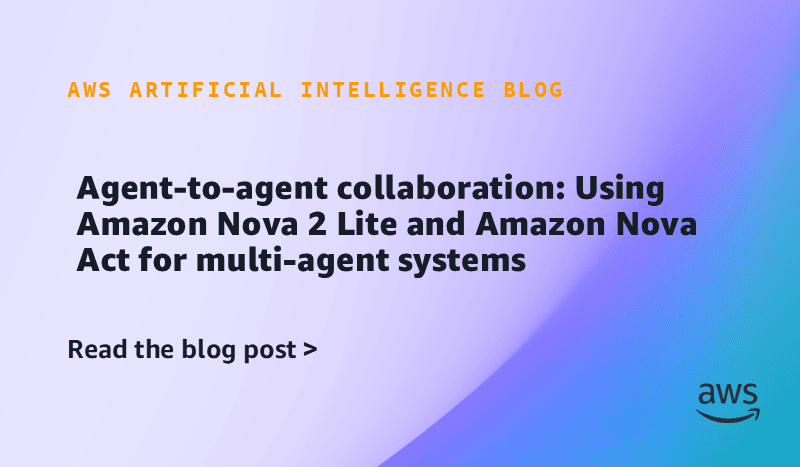
Amazon Web Services (AWS) has recently expanded its generative AI portfolio with the introduction of Amazon Nova, a family of foundation models accessible via Amazon Bedrock. This spotlight focuses on two specific models designed for building sophisticated, cost-effective multi-agent systems: Amazon Nova 2 Lite and Amazon Nova Act. These tools address the growing need for AI systems that can not only process information but also take actions and collaborate autonomously to complete complex workflows. They are designed for developers, enterprises, and data scientists building applications that require long-running tasks, such as data analysis, report generation, and customer service automation. The key benefits include significant cost reduction for high-volume inference, the ability to create AI agents that can execute actions, and a unified framework for orchestrating multiple agents to work together.
Amazon Nova 2 Lite is the most cost-effective model in the Nova family, optimized for speed and low-cost inference. It excels at tasks like text summarization, translation, and classification, making it ideal for high-volume, repetitive workloads. A standout feature is its ability to process long context windows (up to 128K tokens), allowing it to analyze extensive documents or conversation histories without losing track of information. For developers, this means they can build applications that handle complex, multi-step reasoning tasks without incurring prohibitive costs.
Amazon Nova Act, on the other hand, is a specialized model designed to build AI agents that can take actions. Its core capability is to generate structured JSON outputs that can directly invoke tools, APIs, or other functions. This transforms a passive language model into an active participant in a workflow. For example, an agent built with Nova Act can be instructed to "check the inventory for product X, and if stock is low, place a reorder order via the internal API," and it will generate the necessary code to execute that action. This is a significant leap from traditional models that only generate text.
Both models are part of the Amazon Nova family, which is built on AWS's deep infrastructure and optimized for performance on Amazon Bedrock. Amazon Nova 2 Lite uses a mixture-of-experts (MoE) architecture, which allows it to be highly efficient by only activating a subset of its parameters for each token generated. This results in faster response times and lower computational costs compared to dense models of similar size. The model is trained on a diverse dataset of text and code, enabling it to understand and generate content across multiple languages and domains.
Amazon Nova Act leverages a similar foundation but is fine-tuned for function calling and structured output generation. When a user provides a natural language prompt, Nova Act interprets the intent and maps it to a predefined set of tools or APIs. It generates a JSON object that specifies the action to be taken, the parameters required, and any conditional logic. This structured output can be directly consumed by an orchestration layer (like AWS Step Functions or a custom application) to execute the action. This approach reduces the need for complex prompt engineering and makes the agent's behavior more predictable and reliable.
The combination of Nova 2 Lite and Nova Act unlocks powerful multi-agent systems. Consider a customer service scenario: a "Triage Agent" built with Nova 2 Lite can analyze incoming customer queries, summarize the issue, and classify it. Based on the classification, it can then delegate the task to a specialized "Action Agent" built with Nova Act. This Action Agent could access the company's CRM, retrieve customer history, and, if authorized, process a refund or update account details via an API call. This multi-agent collaboration ensures that simple queries are handled efficiently by the cost-effective Nova 2 Lite, while complex, action-oriented tasks are routed to the more capable Nova Act.
Another application is in financial reporting. A team of agents can work together to generate a weekly market summary. One agent (using Nova 2 Lite) can scrape and summarize news articles, while another (using Nova Act) can pull real-time stock data from a financial API. A third agent can then combine these inputs to generate a comprehensive report with actionable insights, all orchestrated automatically. This is a significant improvement over monolithic systems where a single model has to handle all steps, often leading to higher costs and lower accuracy.
Amazon Nova models are priced on a per-token basis, making them highly scalable for different workloads. As of the latest information, Amazon Nova 2 Lite is one of the most cost-effective options available on Amazon Bedrock. For example, the pricing is significantly lower than many frontier models, making it economically viable for high-volume applications like content moderation, data extraction, or large-scale document analysis. Amazon Nova Act is priced similarly, with costs depending on the number of input and output tokens. The key value proposition is the ability to build sophisticated agent systems without the high costs associated with larger, more general-purpose models. For precise, up-to-date pricing, it is always best to check the official Amazon Bedrock pricing page, as costs can vary by region and usage tier.
Pros: -Cost-Effectiveness: Nova 2 Lite offers a compelling price-to-performance ratio, especially for high-volume tasks. -Action-Oriented: Nova Act's ability to generate structured outputs for tool use is a game-changer for building functional agents. -Scalability: Built on AWS infrastructure, these models can scale to handle enterprise-level workloads. -Integration: Seamless integration with other AWS services like Lambda, Step Functions, and S3 simplifies building end-to-end workflows.
Cons: -Learning Curve: Building multi-agent systems requires a solid understanding of prompt engineering, API integration, and orchestration patterns. -Vendor Lock-in: These tools are deeply integrated into the AWS ecosystem, which may not be suitable for organizations with a multi-cloud or non-AWS strategy. -Model Specificity: While powerful, Nova 2 Lite is not a frontier model and may not excel at highly creative or nuanced tasks compared to larger models like GPT-4 or Claude.
Who Should Use It? These tools are ideal for developers and enterprises already invested in the AWS ecosystem who are looking to build scalable, cost-effective AI applications. They are particularly well-suited for use cases involving document processing, customer service automation, data analysis, and any workflow that can be broken down into a series of autonomous, collaborative steps. Startups and mid-sized companies will find the pricing especially attractive for prototyping and deploying production-grade agent systems.
FAQ
Related Topics
AI Spotlights
Unleashing Today's trailblazer, this week's game-changers, and this month's legends in AI. Dive in and discover tools that matter.

Claude Fable 5 Review: Mythos Power with Safety
Gemma 4 12B Review: Multimodal AI on Your Laptop

Google Dreambeans Review: AI Cartoon Stories
NVIDIA Nemotron 3 Ultra: 550B MoE LLM Review

Meta AI Agent for Enterprises: Global Launch
Gemini Omni and 3.5: Google's Latest AI Models
Step 3.7 Flash Review: 198B MoE Vision-Language Model

Gemini Spark Review: Google's AI Agent Goes Personal
Microsoft Agent Governance Toolkit Review
Gemini Spark AI Agent Review: Always-On Automation

MAI-Thinking-1 Review: Microsoft's Advanced Reasoning AI
Microsoft Scout Review: OpenClaw-Powered AI Assistant
Microsoft MDASH Review: 100+ AI Agents for Threat Hunting

Google Phone App Fake Call Detection Review
Stable Audio 3 Review: Fast AI Audio Generation
Claude Opus 4.8: Dynamic Workflows & Faster AI
Microsoft 365 Copilot Redesign: 2x Speed Boost

Perplexity Bumblebee: AI Supply Chain Security Scanner

AWS OpenSearch Serverless Review: Enterprise Search Reimagined
OSCAR: 2-Bit KV Cache Quantization for LLMs
You Might Like These Latest News
All AI NewsStay informed with the latest AI news, breakthroughs, trends, and updates shaping the future of artificial intelligence.
Microsoft Patches Zero-Day After Researcher Disclosure
Jun 10, 2026
NVIDIA GPUs Power Apple's Private Cloud Compute Expansion
Jun 10, 2026
GM Launches Vehicle-to-Grid Tech to Power AI Data Centers
Jun 10, 2026
Alphabet's $85B AI Investment Signals Major Shift
Jun 5, 2026
AI Cognitive Fatigue: Work Smarter, Not Harder
Jun 5, 2026
Nvidia Unveils Physical AI Research with Cosmos 3
Jun 5, 2026
Airbnb CEO Launches AI Lab to Build Custom LLMs
Jun 5, 2026
Anthropic's IPO Filing Balances Growth With Responsible AI
Jun 3, 2026
Meta's AI Chatbot Exploited to Hijack Instagram Accounts
Jun 3, 2026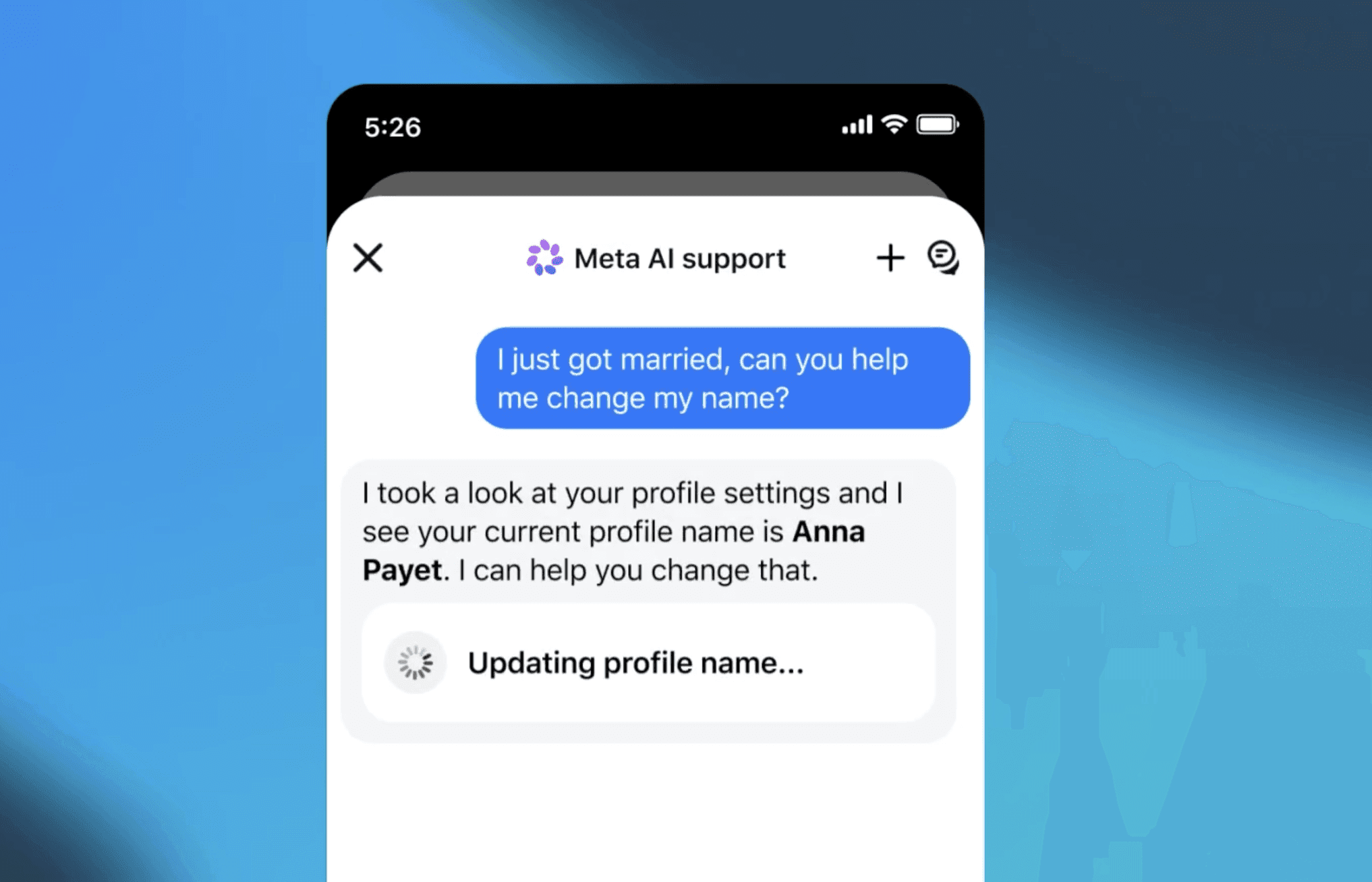

Discover the top AI tools handpicked daily by our editors to help you stay ahead with the latest and most innovative solutions.