









Age of AI Toolsv2.beta
For YouJobsUse Cases
Media-HubNEW

Join Our Community

Get the earliest access to hand-picked content weekly for free.

Spam-free guaranteed! Only insights.
Join Our Community

Get the earliest access to hand-picked content weekly for free.

Spam-free guaranteed! Only insights.

Trusted by Leading Review and Discovery Websites

Age of AI Tools on Product HuntApproved on SaaSHubAlternativeTo
AI Tools
  • For You!
  • Discover All AI Tools
  • Best AI Tools
  • Free AI Tools
  • Tools of the DayNEW
  • All Use Cases
  • All Jobs
Trend UseCases
  • AI Image Generators
  • AI Video Generators
  • AI Voice Generators
Trend Jobs
  • Graphic Designer
  • SEO Specialist
  • Email Marketing Specialist
Media Hub
  • Go to Media Hub
  • AI News
  • AI Tools Spotlights
Age of AI Tools
  • What's New
  • Story of Age of AI Tools
  • Cookies & Privacy
  • Terms & Conditions
  • Request Update
  • Bug Report
  • Contact Us
Submit & Advertise
  • Submit AI Tool
  • Promote Your Tool50% Off

Agent of AI Age

Looking to discover new AI tools? Just ask our AI Agent

Copyright © 2026 Age of AI Tools. All Rights Reserved.

Media HubTools SpotlightOSGym Review: $0.23/Day OS Infrastructure for AI Agents
9 Apr 20265 min read

OSGym Review: $0.23/Day OS Infrastructure for AI Agents

OSGym Review: $0.23/Day OS Infrastructure for AI Agents

🎯 Quick Impact Summary

OSGym represents a fundamental shift in how AI researchers approach the infrastructure challenge of training computer-using agents. By managing 1,000+ OS replicas at just $0.23 per day, it solves what has been one of the hardest plumbing problems in modern AI: spinning up and orchestrating full operating systems for agent training at scale. This breakthrough makes previously prohibitive research accessible to teams of any size.

What's New in OSGym

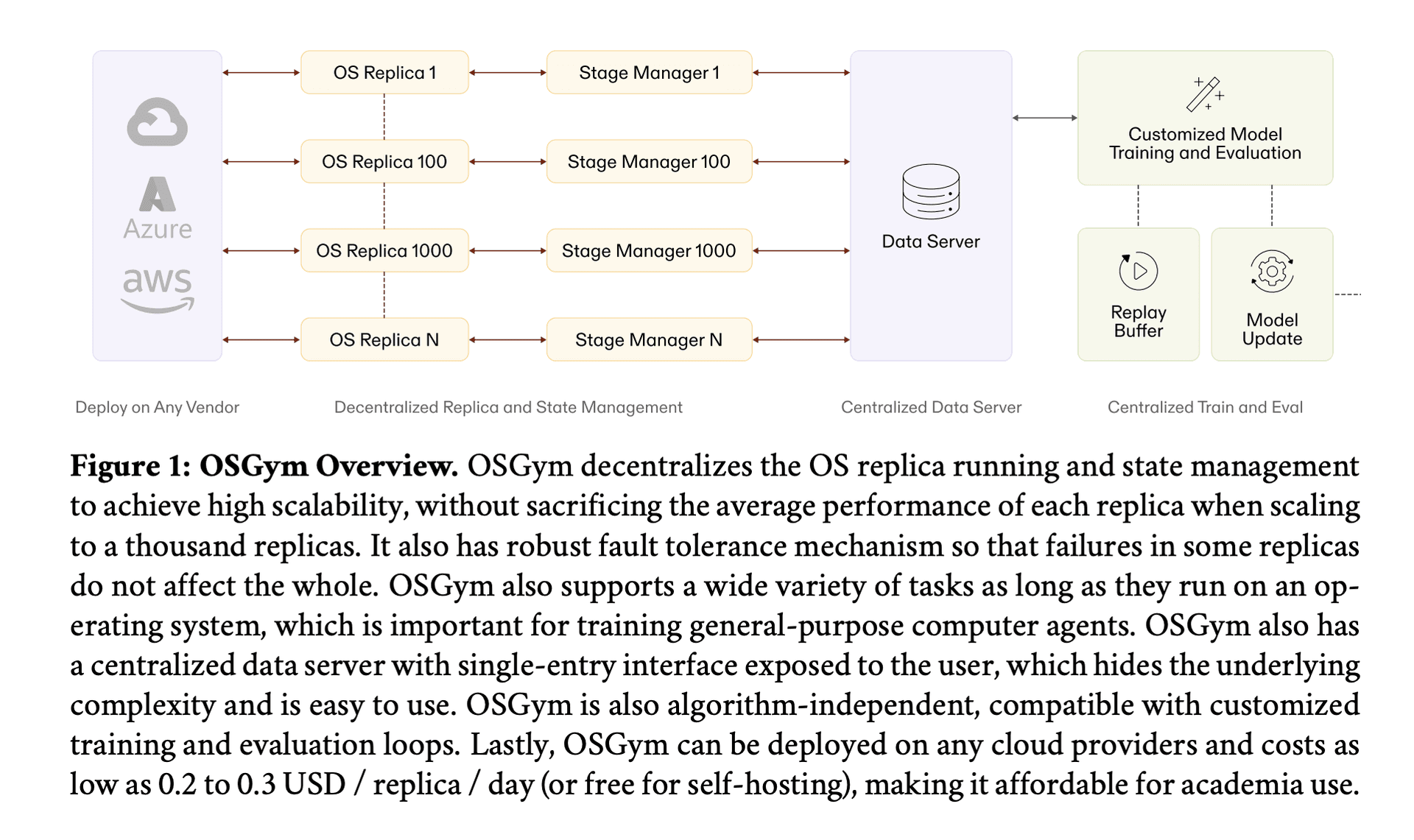
OSGym introduces a revolutionary approach to OS infrastructure management designed specifically for training AI agents that interact with computers. The framework tackles the core challenge of scaling computer use agent research without prohibitive costs.

  • 1,000+ Replica Management: Simultaneously orchestrates over 1,000 full operating system instances with unified control, enabling massive-scale agent training experiments that were previously impossible.
  • Ultra-Low Cost Structure: Delivers complete OS infrastructure at $0.23 per day for 1,000 replicas, reducing infrastructure costs by orders of magnitude compared to traditional approaches.
  • Computer Use Agent Optimization: Purpose-built for training AI agents that can open applications, click buttons, navigate web interfaces, and write code through direct OS interaction.
  • Scalable Architecture: Automatically handles replica provisioning, management, and teardown, allowing researchers to focus on model development rather than infrastructure maintenance.
  • Unified Control Plane: Provides centralized management across all replicas, simplifying deployment, monitoring, and experimentation workflows.
  • Research-Ready Integration: Designed with AI researcher workflows in mind, enabling rapid iteration on agent training pipelines and benchmarking.

Technical Specifications

OSGym is engineered as a specialized infrastructure framework addressing the unique demands of computer use agent research at scale.

  • Replica Capacity: Manages 1,000+ concurrent operating system instances with coordinated lifecycle management and resource allocation.
  • Cost Efficiency: Achieves $0.23 per day operational cost for full-scale deployments, representing a dramatic reduction in infrastructure overhead.
  • Architecture Type: Infrastructure-as-Code framework designed for orchestrating virtualized OS environments with automated provisioning and scaling.
  • Integration Focus: Built to interface with AI agent training pipelines, enabling seamless connection between model training and OS interaction simulation.
  • Deployment Model: Cloud-native infrastructure framework supporting distributed OS replica management across multiple nodes and regions.

Official Benefits

  • Cost Reduction: Operates 1,000+ OS replicas at $0.23 per day, making large-scale agent training accessible to researchers with limited infrastructure budgets.
  • Scalability Without Complexity: Eliminates manual OS provisioning and management, allowing teams to scale from dozens to thousands of replicas without proportional operational overhead.
  • Accelerated Research Velocity: Reduces infrastructure setup time from weeks to hours, enabling researchers to iterate faster on agent training experiments and benchmarks.
  • Democratized Access: Makes computer use agent research feasible for academic institutions and smaller organizations previously priced out of this research domain.
  • Unified Management: Centralizes control across all replicas, reducing operational complexity and enabling consistent experimentation environments.

Real-World Translation

What Each Feature Actually Means:

  • 1,000+ Replica Management: Instead of manually spinning up individual virtual machines and managing each one separately, a researcher can launch and coordinate thousands of OS instances simultaneously through a single interface. This means running 10,000 parallel agent training experiments overnight without manual intervention.
  • $0.23/Day Cost: A research team can now afford to run continuous large-scale agent training for the cost of a coffee, where the same infrastructure would have cost hundreds or thousands of dollars monthly with traditional cloud providers. This transforms computer use agent research from a resource-intensive luxury to an accessible standard practice.
  • Computer Use Agent Optimization: The framework is specifically tuned for agents that need to interact with real operating systems, not generic cloud infrastructure. This means agents can be trained to handle real-world tasks like opening Slack, writing emails, or navigating web applications with the exact same OS environment they'll encounter in production.
  • Unified Control Plane: Instead of SSH-ing into individual machines or managing separate cloud accounts, researchers get one dashboard to deploy, monitor, and adjust all 1,000+ replicas. This reduces operational friction from hours of manual work to minutes of configuration.
  • Research-Ready Integration: The framework speaks the language of AI research, integrating directly with common agent training pipelines and benchmarking tools. A researcher can connect their training code to OSGym without building custom infrastructure adapters.

Before vs After

Before

Training computer-using AI agents required researchers to manually provision and manage dozens or hundreds of individual virtual machines, often across multiple cloud providers. Infrastructure costs spiraled quickly, and operational overhead consumed significant research time. Most teams couldn't afford to run large-scale experiments, limiting the scope and speed of agent research.

After

OSGym automates the entire OS infrastructure layer, allowing researchers to provision and manage 1,000+ replicas through a unified interface. Infrastructure costs drop to $0.23 per day, and operational overhead becomes negligible. Teams can now run massive-scale experiments that were previously impossible, dramatically accelerating research velocity and democratizing access to this research domain.

📈 Expected Impact: Large-scale computer use agent research becomes 100x more cost-effective and operationally simpler, enabling exponential growth in agent training experiments and breakthroughs.

Job Relevance Analysis

AI Researcher

HIGH Impact
  • Use Case: AI researchers use OSGym to train and benchmark computer-using agents at massive scale, running thousands of parallel experiments to test different agent architectures, prompting strategies, and learning approaches.
  • Key Benefit: Reduces infrastructure setup from weeks to hours and cuts costs by 100x, allowing researchers to focus entirely on model innovation rather than infrastructure management.
  • Workflow Integration: Integrates directly into research pipelines, enabling researchers to connect training code to OSGym's replica management system and iterate rapidly on agent capabilities.
  • Skill Development: Researchers develop expertise in distributed agent training, large-scale experimentation design, and infrastructure-as-code practices that are increasingly critical in modern AI research.
  • Competitive Advantage: Teams using OSGym can run 10-100x more experiments than competitors with traditional infrastructure, accelerating discovery and enabling research previously impossible due to cost constraints.
AI Researcher

Advance innovation with AI tools for academic research, data analysis, knowledge representation, decision-making, and AI-powered chatbots.

6,692 Tools
AI Researcher

Automation Engineer

HIGH Impact
  • Use Case: Automation engineers use OSGym to build, test, and deploy computer-using agents that automate real-world tasks like data entry, web scraping, application workflows, and cross-system integrations.
  • Key Benefit: Provides a scalable, cost-effective platform to test automation agents against thousands of OS configurations and scenarios before production deployment.
  • Workflow Integration: Fits into CI/CD pipelines for agent testing, enabling automated validation of agent behavior across diverse environments without manual testing overhead.
  • Skill Development: Engineers develop expertise in agent-based automation architecture, distributed testing frameworks, and infrastructure orchestration for AI-driven systems.
  • Practical Application: An engineer can test an email automation agent against 1,000 different email client configurations and OS versions simultaneously, catching edge cases that would take months to discover manually.
Automation Engineer

Increase your productivity with these AI solutions for automation, quality assurance, integration, collaboration, and code creation.

5,288 Tools
Automation Engineer

Cybersecurity & Detection

MEDIUM Impact
  • Use Case: Security professionals use OSGym to train and test AI agents that detect malicious behavior, simulate attack scenarios, and validate security controls across diverse OS environments.
  • Key Benefit: Enables large-scale security testing and threat simulation at a fraction of traditional infrastructure costs, improving detection model robustness through diverse scenario exposure.
  • Workflow Integration: Integrates into security testing pipelines, allowing automated validation of detection agents against thousands of attack scenarios and OS configurations.
  • Skill Development: Security teams develop expertise in AI-driven threat detection, adversarial testing frameworks, and infrastructure-scale security validation.
  • Practical Application: A security team can train a malware detection agent against 1,000 different OS states and attack vectors simultaneously, significantly improving detection accuracy and reducing false positives.

Getting Started

How to Access

  • Visit the OSGym Repository: Access the framework through its official GitHub repository or documentation site where the latest version and setup instructions are available.
  • Review Infrastructure Requirements: Ensure your environment meets the prerequisites for running OSGym, including cloud provider access or local virtualization capabilities.
  • Configure Your Environment: Set up API credentials, define replica specifications, and configure your preferred cloud provider integration.
  • Deploy Initial Replicas: Launch your first batch of OS replicas using OSGym's provisioning tools and verify connectivity and performance.

Quick Start Guide

For Beginners:

  1. Install OSGym using the provided package manager or container image and verify installation with a simple health check command.
  2. Create a basic configuration file specifying the number of OS replicas you want to provision and their resource specifications.
  3. Deploy your first replica batch using the provisioning command and monitor the deployment status through the unified dashboard.
  4. Connect a simple test script to verify that your replicas are responding correctly and ready for agent training.

For Power Users:

  1. Configure advanced replica specifications including custom OS images, resource allocation policies, and network topology for your specific research needs.
  2. Integrate OSGym with your existing CI/CD pipeline and agent training framework using the provided APIs and SDKs.
  3. Set up automated scaling policies that adjust replica count based on training load and implement cost optimization rules.
  4. Deploy monitoring and logging infrastructure to track replica health, agent performance metrics, and cost tracking across all instances.
  5. Implement custom orchestration workflows that automate replica lifecycle management, experiment scheduling, and result aggregation.

Pro Tips

  • Start Small, Scale Gradually: Begin with 10-50 replicas to understand the platform and optimize your workflows before scaling to 1,000+, ensuring you catch configuration issues early.
  • Leverage Cost Monitoring: Use built-in cost tracking tools to monitor spending in real-time and identify optimization opportunities, ensuring you stay within budget while maximizing experimental throughput.
  • Implement Replica Pooling: Pre-provision replica pools during off-peak hours when costs are lower, then activate them during peak research periods to optimize cost-efficiency.
  • Standardize OS Images: Create standardized OS images for your research domain and version them carefully, ensuring reproducibility across experiments and reducing deployment time.

FAQ

Related Topics

OSGymAI infrastructurecomputer use agentsagent training platform

Table of contents

What's New in OSGymTechnical SpecificationsOfficial BenefitsReal-World TranslationJob Relevance AnalysisGetting StartedFAQ
Impact LevelHIGH
Update ReleasedApril 8, 2026

Best for

AI ResearcherAutomation EngineerCybersecurity & Detection

Related Use Cases

AI Productivity ToolsAI Automation ToolsAI Platform-Specific Tools

Related Articles

ChatGPT Pro $100/Month: New Tier Review
Google Gemini 3D Models: Interactive AI Simulations
Google Photos AI Enhance: Smart Photo Editing Review
All AI Spotlights

Editor's Pick Articles

Google Photos AI Enhance: Smart Photo Editing Review
Poke AI Agent: Text-Based Automation for Everyone
Intel Joins Elon Musk's Terafab Semiconductor Project
All Articles
Special offer for AI Owners – 50% OFF Promotional Plans

Join Our Community

Get the earliest access to hand-picked content weekly for free.

Spam-free guaranteed! Only insights.

Follow Us on Socials

Don't Miss AI Topics

ai art generatorai voice generatorai text generatorai avatar generatorai designai writing assistantai audio generatorai content generatorai dubbingai graphic designai banner generatorai in dropshipping

AI Spotlights

Unleashing Today's trailblazer, this week's game-changers, and this month's legends in AI. Dive in and discover tools that matter.

All AI Spotlights
ChatGPT Pro $100/Month: New Tier Review

ChatGPT Pro $100/Month: New Tier Review

Google Gemini 3D Models: Interactive AI Simulations

Google Gemini 3D Models: Interactive AI Simulations

Google Photos AI Enhance: Smart Photo Editing Review

Google Photos AI Enhance: Smart Photo Editing Review

Poke AI Agent: Text-Based Automation for Everyone

Poke AI Agent: Text-Based Automation for Everyone

Tubi ChatGPT App: First Streamer Native Integration

Tubi ChatGPT App: First Streamer Native Integration

Google's Offline AI Dictation App Review

Google's Offline AI Dictation App Review

MaxToki Review: AI Predicts Cellular Aging

MaxToki Review: AI Predicts Cellular Aging

Apple Music AI Playlist Curation Review

Apple Music AI Playlist Curation Review

Microsoft's New Voice & Image AI Models

Microsoft's New Voice & Image AI Models

Trinity Large Thinking: Open-Source Reasoning Model

Trinity Large Thinking: Open-Source Reasoning Model

Gemini API Inference Tiers: Cost vs Reliability

Gemini API Inference Tiers: Cost vs Reliability

Slack AI Makeover: 30 New Features Transform Productivity

Slack AI Makeover: 30 New Features Transform Productivity

ChatGPT on Apple CarPlay: Voice AI Now in Your Car

ChatGPT on Apple CarPlay: Voice AI Now in Your Car

GLM-5V-Turbo Review: Vision Coding Model

GLM-5V-Turbo Review: Vision Coding Model

Harrier-OSS-v1: Microsoft's SOTA Multilingual Embedding Models

Harrier-OSS-v1: Microsoft's SOTA Multilingual Embedding Models

Copilot Researcher: Microsoft's AI Accuracy Upgrade

Copilot Researcher: Microsoft's AI Accuracy Upgrade

Google TurboQuant Review: Real-Time AI Quantization

Google TurboQuant Review: Real-Time AI Quantization

A-Evolve: Automated AI Agent Development Framework

A-Evolve: Automated AI Agent Development Framework

Gemini Switching Tools: Import Chats from Other AI Chatbots

Gemini Switching Tools: Import Chats from Other AI Chatbots

You Might Like These Latest News

All AI News

Stay informed with the latest AI news, breakthroughs, trends, and updates shaping the future of artificial intelligence.

Black Forest Labs Expands AI Image Generation to Physical AI

Apr 10, 2026
Black Forest Labs Expands AI Image Generation to Physical AI

Meta AI App Jumps to No. 5 After Muse Spark Launch

Apr 10, 2026
Meta AI App Jumps to No. 5 After Muse Spark Launch

Google and Intel Partner on Custom AI Chips

Apr 10, 2026
Google and Intel Partner on Custom AI Chips

Florida AG Investigates OpenAI Over FSU Shooting

Apr 10, 2026
Florida AG Investigates OpenAI Over FSU Shooting

AI Startup Mercor Faces Crisis After Data Breach

Apr 10, 2026
AI Startup Mercor Faces Crisis After Data Breach

Tech Giants Unite on AI Cybersecurity Initiative

Apr 9, 2026
Tech Giants Unite on AI Cybersecurity Initiative

Anthropic Launches AI Cybersecurity Initiative

Apr 9, 2026
Anthropic Launches AI Cybersecurity Initiative

Anthropic's AI Model Finds Security Flaws in Every OS

Apr 9, 2026
Anthropic's AI Model Finds Security Flaws in Every OS

Nvidia-Backed Firmus Hits $5.5B Valuation

Apr 9, 2026
Nvidia-Backed Firmus Hits $5.5B Valuation
Tools of The Day

Tools of The Day

Discover the top AI tools handpicked daily by our editors to help you stay ahead with the latest and most innovative solutions.


10MAR
Adobe Illustrator
Adobe Illustrator
9MAR
Adobe Firefly
Adobe Firefly
8MAR
Adobe Sensei
Adobe Sensei
7MAR
Adobe Photoshop
Adobe Photoshop
6MAR
Adobe Firefly
Adobe Firefly
5MAR
Shap-E
Shap-E
4MAR
Point-E
Point-E

Explore AI Tools of The Day