









Age of AI Toolsv2.beta
For YouJobsUse Cases
Media-HubNEW

Join Our Community

Get the earliest access to hand-picked content weekly for free.

Spam-free guaranteed! Only insights.
Join Our Community

Get the earliest access to hand-picked content weekly for free.

Spam-free guaranteed! Only insights.

Trusted by Leading Review and Discovery Websites

Age of AI Tools on Product HuntApproved on SaaSHubAlternativeTo
AI Tools
  • For You!
  • Discover All AI Tools
  • Best AI Tools
  • Free AI Tools
  • Tools of the DayNEW
  • All Use Cases
  • All Jobs
Trend UseCases
  • AI Image Generators
  • AI Video Generators
  • AI Voice Generators
Trend Jobs
  • Graphic Designer
  • SEO Specialist
  • Email Marketing Specialist
Media Hub
  • Go to Media Hub
  • AI News
  • AI Tools Spotlights
Age of AI Tools
  • What's New
  • Story of Age of AI Tools
  • Cookies & Privacy
  • Terms & Conditions
  • Request Update
  • Bug Report
  • Contact Us
Submit & Advertise
  • Submit AI Tool
  • Promote Your Tool50% Off

Agent of AI Age

Looking to discover new AI tools? Just ask our AI Agent

Copyright © 2026 Age of AI Tools. All Rights Reserved.

Media HubTools SpotlightZyphra TSP: 2.6x Faster AI Training Review
6 May 20268 min read

Zyphra TSP: 2.6x Faster AI Training Review

Zyphra TSP: 2.6x Faster AI Training Review

🎯 Quick Impact Summary

Zyphra's Tensor and Sequence Parallelism (TSP) represents a breakthrough in distributed AI training efficiency, delivering 2.6x throughput gains over conventional tensor parallelism plus sequence parallelism approaches. By folding both parallelism strategies across the same GPU axis, TSP cuts parameter and activation memory requirements while maintaining hardware compatibility. This innovation directly addresses the bottleneck that has limited large language model training scalability for researchers and enterprises working with constrained GPU resources.

What's New in Zyphra TSP

Zyphra's TSP strategy introduces a fundamentally different approach to distributed training that optimizes how data flows across GPU clusters. Rather than treating tensor parallelism and sequence parallelism as separate mechanisms, TSP integrates them into a unified framework that maximizes hardware utilization.

  • Folded Parallelism Architecture: Combines tensor and sequence parallelism on the same GPU axis, eliminating redundant memory allocation and communication overhead that traditional approaches require
  • 2.6x Throughput Improvement: Achieves significant speedup compared to matched tensor parallelism plus sequence parallelism baselines, directly reducing training time for large models
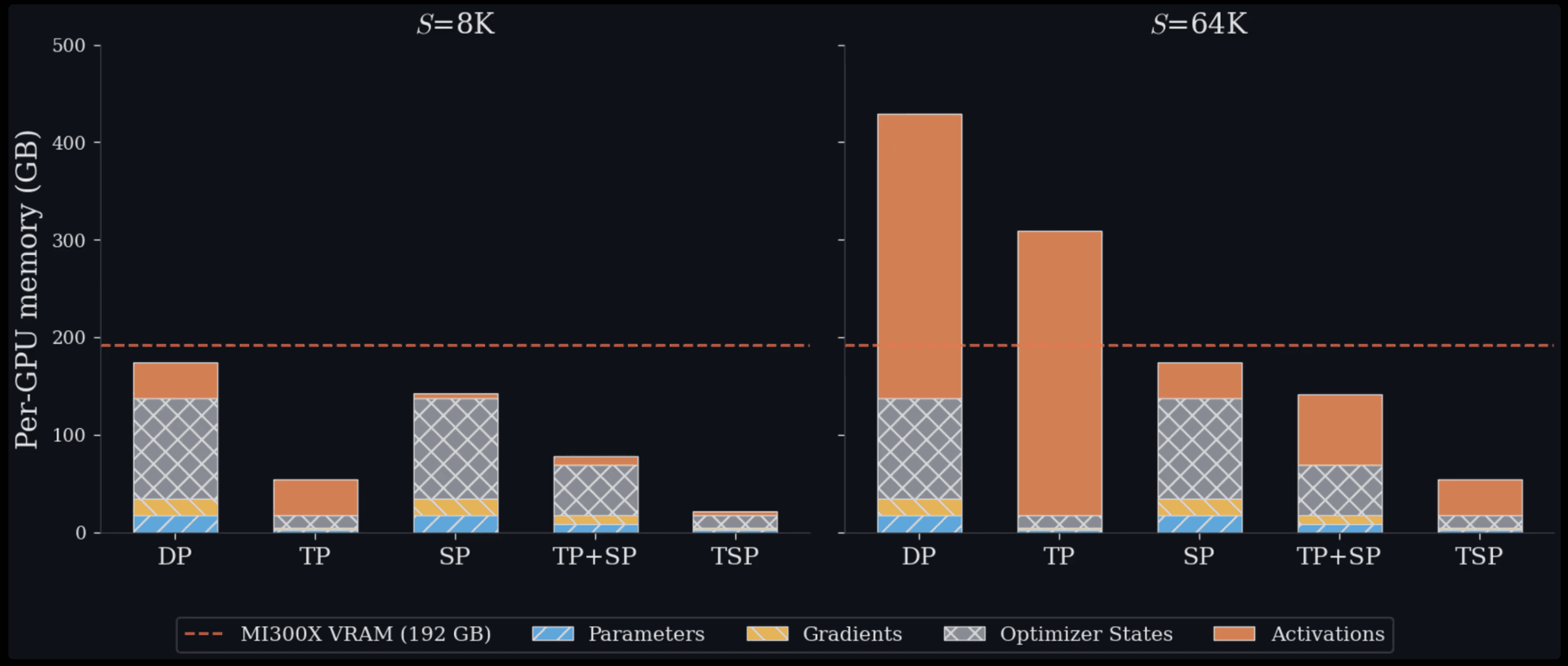
  • Reduced Memory Footprint: Decreases both parameter and activation memory requirements across the same computational dimension, enabling training of larger models on existing hardware
  • Hardware-Aware Design: Automatically adapts to specific GPU configurations and cluster topologies, ensuring optimal performance regardless of infrastructure setup
  • Inference Acceleration: Extends benefits beyond training to inference workloads, improving real-time model serving performance and reducing latency
  • Seamless Integration: Works with existing distributed training frameworks without requiring complete architectural rewrites

Technical Specifications

TSP operates on principles of distributed computing optimization that differ significantly from conventional approaches. Understanding the technical foundation helps explain why the performance gains are so substantial.

  • Parallelism Model: Folded strategy that merges tensor and sequence parallelism dimensions, reducing communication patterns and synchronization points across GPU clusters
  • Memory Optimization: Eliminates duplicate parameter storage and reduces activation memory by consolidating parallel operations on unified GPU axes
  • Throughput Metrics: Delivers 2.6x improvement over matched TP+SP baselines in measured throughput benchmarks across standard model sizes
  • Compatibility: Supports standard GPU clusters and distributed training frameworks, requiring no specialized hardware modifications
  • Scalability: Maintains efficiency gains across varying cluster sizes and model architectures, from medium-scale to enterprise deployments

Official Benefits

  • 2.6x faster training throughput compared to traditional tensor parallelism combined with sequence parallelism approaches
  • Reduced memory consumption for both parameters and activations, enabling larger model training on fixed GPU budgets
  • Lower infrastructure costs by maximizing utilization of existing GPU clusters without requiring additional hardware investment
  • Faster inference serving with improved throughput for real-time model deployment and reduced latency in production environments
  • Simplified distributed training through unified parallelism strategy that reduces implementation complexity and debugging overhead

Real-World Translation

What Each Feature Actually Means:

  • Folded Parallelism Architecture: Instead of running tensor parallelism and sequence parallelism as separate, competing processes that each consume GPU memory independently, TSP merges them into one coordinated system. A research team training a 70-billion parameter model can now fit it on the same number of GPUs that previously required additional hardware, or train even larger models with the same resources.
  • 2.6x Throughput Improvement: Training that previously took 10 days now completes in under 4 days. For enterprises running continuous model refinement, this translates directly to faster iteration cycles, quicker time-to-production for new model versions, and measurable cost savings on GPU rental or datacenter utilization.
  • Reduced Memory Footprint: Teams working with constrained budgets can now train models that were previously impossible on their hardware. A startup with 8 high-end GPUs can now tackle projects that previously required 12-16 GPUs, making advanced AI development accessible to resource-limited organizations.
  • Hardware-Aware Design: The system automatically detects your specific GPU configuration and cluster topology, then optimizes parallelism strategy accordingly. No manual tuning or configuration files needed; it just works better on your exact hardware setup than generic approaches.
  • Inference Acceleration: Deployed models serving real-time requests experience lower latency and higher throughput. A chatbot API can now handle 2.6x more concurrent users with the same hardware, or reduce response times for existing traffic loads.

Before vs After

Before

Training large language models required researchers to choose between tensor parallelism and sequence parallelism, each with distinct memory and communication tradeoffs. Teams had to manually balance these approaches, often resulting in suboptimal hardware utilization. Scaling to larger models meant purchasing additional GPUs or accepting longer training timelines.

After

With TSP, a single unified strategy automatically optimizes both parallelism dimensions across the same GPU axis. The same hardware now delivers 2.6x throughput improvements, enabling faster training cycles and larger model support without infrastructure expansion. Memory efficiency gains allow teams to train models that previously exceeded their hardware capabilities.

📈 Expected Impact: Organizations can reduce AI training costs by 60% or accelerate model development cycles by 2.6x using existing GPU infrastructure.

Job Relevance Analysis

AI Researcher

HIGH Impact
  • Use Case: Researchers use TSP to accelerate experimentation cycles when training large language models, enabling rapid iteration on model architectures, hyperparameters, and training strategies without waiting days for single training runs to complete
  • Key Benefit: 2.6x faster training means research papers can be completed in weeks instead of months, and hypotheses can be tested more rapidly with real experimental data rather than theoretical projections
  • Workflow Integration: TSP integrates directly into existing distributed training pipelines, requiring minimal code changes while delivering immediate performance gains that compound across dozens of experiments
  • Skill Development: Researchers deepen understanding of distributed computing optimization and hardware-aware algorithm design, skills increasingly critical for cutting-edge AI development
  • Resource Efficiency: Limited GPU budgets stretch further, allowing researchers to explore more model variants and training approaches within the same computational budget
AI Researcher

Advance innovation with AI tools for academic research, data analysis, knowledge representation, decision-making, and AI-powered chatbots.

6,692 Tools
AI Researcher

3D Modeler

MEDIUM Impact
  • Use Case: 3D modelers working with AI-powered tools for texture generation, model optimization, or neural rendering benefit from faster inference speeds when these tools run on TSP-optimized backends
  • Key Benefit: Real-time AI-assisted modeling features respond faster, reducing workflow interruptions and enabling more fluid creative iteration when using AI enhancement tools
  • Workflow Integration: TSP improvements manifest as faster processing in AI plugins and cloud-based rendering services, transparent to the modeler but noticeably improving responsiveness
  • Skill Development: Understanding how AI acceleration impacts creative tools helps modelers make informed decisions about which AI-powered services to adopt and when to use them
  • Practical Scenario: A modeler using AI-powered texture synthesis sees generation times drop from 30 seconds to 12 seconds per texture, enabling faster exploration of design variations
3D Modeler

Create beautiful 3D renders in minutes with AI tools for 3D design, characters, animation, and VR.

2,644 Tools
3D Modeler

Automation Engineer

HIGH Impact
  • Use Case: Automation engineers deploy AI models for predictive maintenance, anomaly detection, and process optimization; TSP enables these models to run faster inference on edge devices or cloud infrastructure
  • Key Benefit: Faster inference means real-time decision-making becomes feasible for time-sensitive automation tasks, improving response times from seconds to milliseconds
  • Workflow Integration: TSP reduces the computational overhead of AI-powered automation systems, allowing engineers to deploy more sophisticated models on the same hardware budget
  • Skill Development: Engineers learn to optimize AI workloads for production environments, understanding how parallelism strategies impact system reliability and throughput
  • Practical Scenario: An automation system monitoring manufacturing equipment can now process sensor data and generate alerts 2.6x faster, catching equipment failures before they cause downtime
Automation Engineer

Increase your productivity with these AI solutions for automation, quality assurance, integration, collaboration, and code creation.

5,288 Tools
Automation Engineer

Getting Started

How to Access

  • Check Zyphra's Official Resources: Visit Zyphra's documentation and technical papers to understand TSP implementation details and system requirements
  • Verify GPU Compatibility: Confirm your GPU cluster supports distributed training frameworks compatible with TSP (standard configurations like NVIDIA GPUs with PyTorch or similar frameworks)
  • Review Integration Guides: Consult implementation guides for your specific training framework to understand integration steps
  • Contact Zyphra Support: Reach out to Zyphra's team for enterprise deployments or custom configuration assistance

Quick Start Guide

For Beginners:

  1. Start with a small model (7-13 billion parameters) on 2-4 GPUs to understand TSP behavior without complex infrastructure
  2. Use existing training scripts and gradually enable TSP features through framework-specific configuration parameters
  3. Monitor throughput improvements and memory usage to validate that TSP is delivering expected performance gains
  4. Scale to larger models and more GPUs once comfortable with the basic setup

For Power Users:

  1. Profile your current training setup to establish baseline throughput and memory metrics for comparison
  2. Configure TSP parameters to match your specific GPU topology and model architecture for optimal performance
  3. Implement custom communication patterns if needed to further optimize for your cluster's network topology
  4. Integrate TSP with your existing monitoring and logging infrastructure to track performance across training runs
  5. Experiment with different folding strategies to find the optimal balance for your specific workloads

Pro Tips

  • Start Conservative: Enable TSP on a subset of your training pipeline first, then gradually expand to full deployment once you've validated stability and performance gains
  • Monitor Communication Overhead: Watch network bandwidth utilization during training; TSP reduces communication but doesn't eliminate it, so network bottlenecks may still exist
  • Combine with Other Optimizations: TSP works well alongside gradient checkpointing, mixed precision training, and other optimization techniques; stack them for compounding benefits
  • Document Your Configuration: Save your optimal TSP settings for your specific hardware and model architecture; reusing proven configurations accelerates future projects

Getting Started

FAQ

Related Topics

Zyphra TSP reviewtensor sequence parallelismAI training optimizationdistributed deep learninglarge language model trainingGPU parallelism strategy

Table of contents

What's New in Zyphra TSPTechnical SpecificationsOfficial BenefitsReal-World TranslationJob Relevance AnalysisGetting StartedGetting StartedFAQ
Impact LevelHIGH
Update ReleasedMay 4, 2026

Best for

AI Researcher3D ModelerAutomation Engineer

Related Use Cases

AI Summarization ToolsAI Travel ToolsAI Translators

Related Articles

AWS Managed Agents Review: OpenAI Partnership
Glean AI Search Review: Enterprise Search Redefined
ChatGPT Security Update: Advanced Protection Features
All AI Spotlights

Editor's Pick Articles

Claude Personal App Connectors Review
ChatGPT Images 2.0 Review: Better Text & Details
Google Gemini Mac App Review: AI Assistant
All Articles
Special offer for AI Owners – 50% OFF Promotional Plans

Join Our Community

Get the earliest access to hand-picked content weekly for free.

Spam-free guaranteed! Only insights.

Follow Us on Socials

Don't Miss AI Topics

ai art generatorai voice generatorai text generatorai avatar generatorai designai writing assistantai audio generatorai content generatorai dubbingai graphic designai banner generatorai in dropshipping

AI Spotlights

Unleashing Today's trailblazer, this week's game-changers, and this month's legends in AI. Dive in and discover tools that matter.

All AI Spotlights
AWS Managed Agents Review: OpenAI Partnership

AWS Managed Agents Review: OpenAI Partnership

Glean AI Search Review: Enterprise Search Redefined

Glean AI Search Review: Enterprise Search Redefined

ChatGPT Security Update: Advanced Protection Features

ChatGPT Security Update: Advanced Protection Features

Mistral's Cloud Code Platform Review

Mistral's Cloud Code Platform Review

Meta Autodata: AI Framework for Autonomous Data Scientists

Meta Autodata: AI Framework for Autonomous Data Scientists

Gemini API Webhooks: Real-Time AI Automation

Gemini API Webhooks: Real-Time AI Automation

SoundHound OASYS: Self-Learning AI Agent Platform

SoundHound OASYS: Self-Learning AI Agent Platform

Google Home Gemini 3.1: Smarter AI Assistant

Google Home Gemini 3.1: Smarter AI Assistant

Grok Voice Think Fast 1.0 Review: AI Voice

Grok Voice Think Fast 1.0 Review: AI Voice

Vision Banana Review: Google's Instruction-Tuned Image Generator

Vision Banana Review: Google's Instruction-Tuned Image Generator

GitNexus Review: Open-Source Code Knowledge Graph

GitNexus Review: Open-Source Code Knowledge Graph

Qwen3.6-27B Review: Dense Model Outperforms 397B MoE

Qwen3.6-27B Review: Dense Model Outperforms 397B MoE

ChatGPT Workspace Agents: Custom AI Bots for Teams

ChatGPT Workspace Agents: Custom AI Bots for Teams

Google Gemini Enterprise Agent Platform Review

Google Gemini Enterprise Agent Platform Review

Google Workspace Intelligence: AI Office Automation

Google Workspace Intelligence: AI Office Automation

Google Chrome AI Co-Worker: Gemini Auto Browse

Google Chrome AI Co-Worker: Gemini Auto Browse

GPT-5.5 Review: OpenAI's Smarter Coding & Automation Model

GPT-5.5 Review: OpenAI's Smarter Coding & Automation Model

OpenAI Codex with GPT-5.5: AI Coding Revolution

OpenAI Codex with GPT-5.5: AI Coding Revolution

Claude Personal App Connectors Review

Claude Personal App Connectors Review

You Might Like These Latest News

All AI News

Stay informed with the latest AI news, breakthroughs, trends, and updates shaping the future of artificial intelligence.

Microsoft Copilot Hits 20M Paid Users

May 6, 2026
Microsoft Copilot Hits 20M Paid Users

Runway Eyes World Models Beyond AI Video

May 6, 2026
Runway Eyes World Models Beyond AI Video

Microsoft to Exploit New OpenAI Deal

May 6, 2026
Microsoft to Exploit New OpenAI Deal

Legal AI Startup Legora Hits $5.6B Valuation

May 6, 2026
Legal AI Startup Legora Hits $5.6B Valuation

Anthropic Eyes $900B+ Valuation in Major Fundraise

May 6, 2026
Anthropic Eyes $900B+ Valuation in Major Fundraise

Musk Admits xAI Used OpenAI Models to Train Grok

May 6, 2026
Musk Admits xAI Used OpenAI Models to Train Grok

Replit CEO on Cursor deal, Apple fight, and staying independent

May 6, 2026
Replit CEO on Cursor deal, Apple fight, and staying independent

Meta Acquires Robotics Startup for AI Humanoid Push

May 6, 2026
Meta Acquires Robotics Startup for AI Humanoid Push

Oscars Bans AI-Generated Actors and Scripts

May 6, 2026
Oscars Bans AI-Generated Actors and Scripts
Tools of The Day

Tools of The Day

Discover the top AI tools handpicked daily by our editors to help you stay ahead with the latest and most innovative solutions.


10MAR
Adobe Illustrator
Adobe Illustrator
9MAR
Adobe Firefly
Adobe Firefly
8MAR
Adobe Sensei
Adobe Sensei
7MAR
Adobe Photoshop
Adobe Photoshop
6MAR
Adobe Firefly
Adobe Firefly
5MAR
Shap-E
Shap-E
4MAR
Point-E
Point-E

Explore AI Tools of The Day