









Age of AI Toolsv2.beta
For YouJobsUse Cases
Media-HubNEW

Join Our Community

Get the earliest access to hand-picked content weekly for free.

Spam-free guaranteed! Only insights.
Join Our Community

Get the earliest access to hand-picked content weekly for free.

Spam-free guaranteed! Only insights.

Trusted by Leading Review and Discovery Websites

Age of AI Tools on Product HuntApproved on SaaSHubAlternativeTo
AI Tools
  • For You!
  • Discover All AI Tools
  • Best AI Tools
  • Free AI Tools
  • Tools of the DayNEW
  • All Use Cases
  • All Jobs
Trend UseCases
  • AI Image Generators
  • AI Video Generators
  • AI Voice Generators
Trend Jobs
  • Graphic Designer
  • SEO Specialist
  • Email Marketing Specialist
Media Hub
  • Go to Media Hub
  • AI News
  • AI Tools Spotlights
Age of AI Tools
  • What's New
  • Story of Age of AI Tools
  • Cookies & Privacy
  • Terms & Conditions
  • Request Update
  • Bug Report
  • Contact Us
Submit & Advertise
  • Submit AI Tool
  • Promote Your Tool50% Off

Agent of AI Age

Looking to discover new AI tools? Just ask our AI Agent

Copyright © 2026 Age of AI Tools. All Rights Reserved.

Media HubTools SpotlightOpenJarvis Review: Local AI Agents Framework
19 Mar 20268 min read

OpenJarvis Review: Local AI Agents Framework

OpenJarvis Review: Local AI Agents Framework

🎯 Quick Impact Summary

OpenJarvis represents a significant shift toward privacy-preserving AI by enabling personal agents to run entirely on local devices rather than relying on cloud infrastructure. Stanford's Scaling Intelligence Lab has created both a research platform and production-ready framework that addresses the growing demand for on-device AI systems with built-in memory, tool integration, and continuous learning capabilities. This approach fundamentally changes how developers can build personalized AI experiences while maintaining complete data sovereignty.

What's New in OpenJarvis

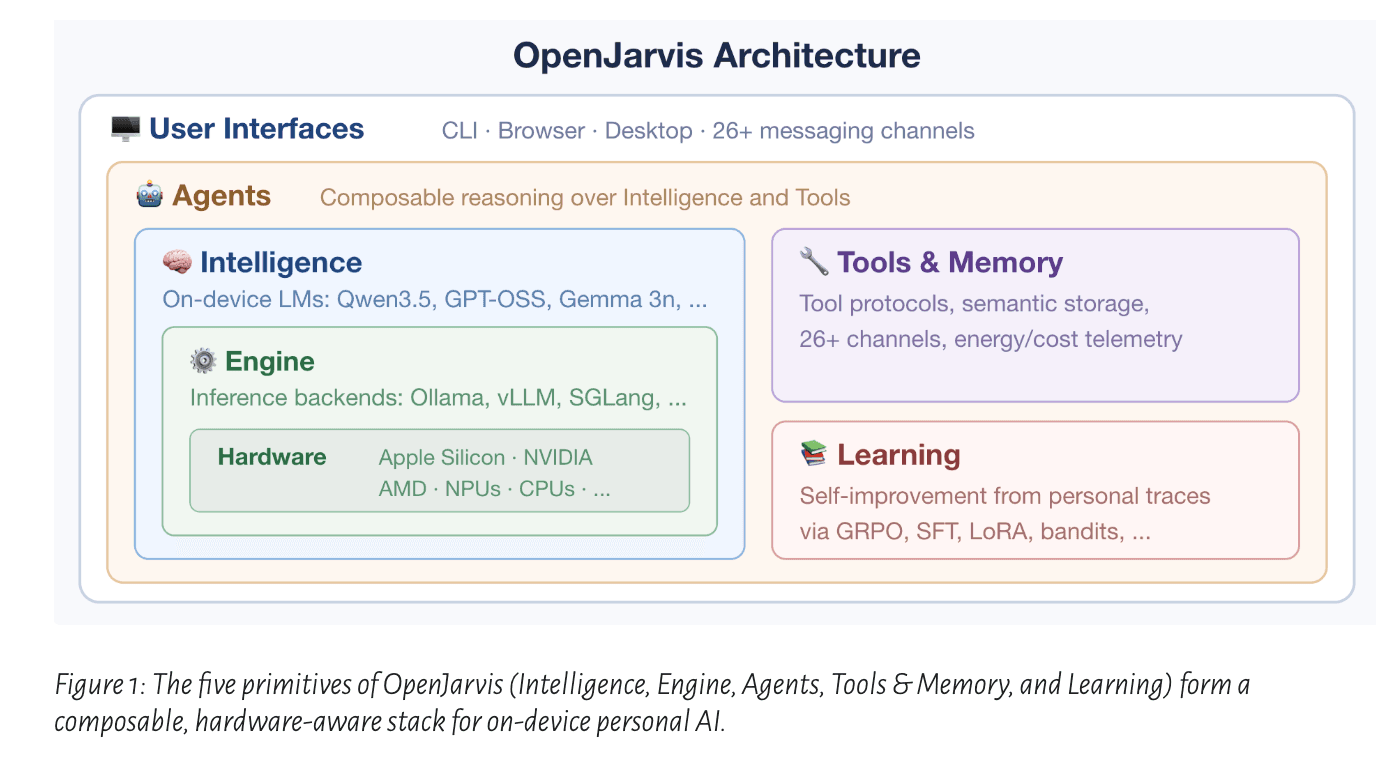
OpenJarvis introduces a comprehensive local-first architecture designed specifically for building personal AI agents that operate entirely on-device. The framework combines multiple critical components into a unified system that goes beyond simple model execution.

  • On-Device Execution: Complete AI agent operation runs locally without cloud dependencies, ensuring data never leaves the user's device and eliminating latency from network requests
  • Integrated Tool System: Built-in framework for connecting AI agents to external tools and APIs, enabling agents to take actions beyond text generation
  • Persistent Memory Architecture: Agents maintain and learn from interaction history, allowing them to develop context-aware responses and improve over time
  • Continuous Learning Capability: System supports ongoing model refinement based on user interactions and feedback without requiring retraining from scratch
  • Production-Ready Infrastructure: Moves beyond research prototype to deployment-ready code, making it accessible for real-world applications
  • Open-Source Foundation: Fully open-source release enables community contributions, transparency, and customization for specific use cases

Technical Specifications

OpenJarvis is built as a comprehensive software stack addressing the full spectrum of on-device AI agent requirements beyond simple model inference.

  • Architecture Type: Modular framework supporting local model execution with integrated memory management, tool orchestration, and learning pipeline components
  • Deployment Model: Runs on consumer hardware including laptops, edge devices, and mobile platforms without requiring cloud connectivity or GPU acceleration for inference
  • Memory System: Implements persistent storage for interaction history, user preferences, and learned patterns that agents can access and update during operation
  • Tool Integration: Provides standardized interfaces for connecting agents to external services, APIs, and local system functions through a unified orchestration layer
  • Research Platform: Designed as both a practical deployment framework and experimental platform for advancing on-device AI research at Stanford's Scaling Intelligence Lab

Official Benefits

  • Complete Data Privacy: All processing occurs locally with zero data transmission to external servers, providing users with absolute control over their personal information
  • Reduced Latency: Eliminates network round-trip delays inherent in cloud-based AI systems, enabling real-time agent responses and interactions
  • Persistent Personalization: Agents develop deeper understanding of individual users through continuous learning from interactions, creating increasingly personalized experiences over time
  • Cost Efficiency: Removes dependency on expensive cloud API calls and subscription services, reducing long-term operational costs for deployed applications
  • Offline Capability: Agents function completely without internet connectivity, making them reliable for environments with limited or unreliable network access

Real-World Translation

What Each Feature Actually Means:

  • On-Device Execution: Instead of sending every user request to a distant server and waiting for a response, your AI agent thinks and acts right on your computer. A personal assistant running locally responds instantly to questions about your calendar without uploading your schedule to the cloud
  • Integrated Tool System: Your AI agent isn't limited to conversation. It can actually do things like send emails, control smart home devices, or fetch information from your local files by connecting to tools through OpenJarvis's unified system
  • Persistent Memory Architecture: Rather than starting fresh with each conversation, your agent remembers previous interactions and learns your preferences. After several conversations about your work style, it anticipates your needs and suggests relevant actions proactively
  • Continuous Learning: The system improves through use without requiring you to retrain models or update software. When you correct the agent's behavior or provide feedback, it adapts its responses for future interactions
  • Production-Ready Infrastructure: You're not working with experimental code. OpenJarvis provides the complete software stack needed to deploy agents in real applications, not just research prototypes

Before vs After

Before

Traditional cloud-based AI systems require constant internet connectivity and send all user data to external servers. Developers building personal AI agents must assemble multiple disparate tools and services, managing complex integrations between model inference, memory systems, and tool orchestration. Privacy-conscious users have limited options for AI assistance that keeps their information local.

After

OpenJarvis provides a unified framework where AI agents run entirely on local devices with built-in memory, tool integration, and learning capabilities. Users maintain complete data sovereignty while developers gain a production-ready platform that eliminates the need to integrate multiple separate systems. Agents become truly personal, learning from interactions and improving over time without compromising privacy.

📈 Expected Impact: Organizations and individual developers can now deploy privacy-first AI agents that operate entirely locally while maintaining the sophisticated capabilities previously available only through cloud services.

Job Relevance Analysis

AI Researcher

HIGH Impact
  • Use Case: Researchers use OpenJarvis as both an experimental platform and deployment testbed for advancing on-device AI agent research, testing new architectures for memory systems, tool integration, and continuous learning without relying on proprietary cloud infrastructure
  • Key Benefit: Direct access to a complete, open-source software stack designed specifically for personal AI agents enables rapid prototyping of novel approaches to on-device learning and agent behavior
  • Workflow Integration: Replaces the need to build custom infrastructure from scratch, allowing researchers to focus on algorithmic innovation rather than engineering foundational systems
  • Skill Development: Working with OpenJarvis develops expertise in local-first AI architecture, edge computing constraints, and practical deployment considerations that bridge research and production
  • Research Opportunities: The framework enables studies on privacy-preserving AI, federated learning patterns, and on-device personalization that address critical industry needs
AI Researcher

Advance innovation with AI tools for academic research, data analysis, knowledge representation, decision-making, and AI-powered chatbots.

6,692 Tools
AI Researcher

Data Scientist

MEDIUM Impact
  • Use Case: Data scientists leverage OpenJarvis to build personalized AI systems that learn from user interactions, implementing memory systems and continuous learning pipelines that improve model performance over time
  • Key Benefit: Eliminates the complexity of managing separate systems for model serving, memory management, and learning orchestration by providing integrated tools within a single framework
  • Workflow Integration: Fits into existing data science workflows by handling infrastructure concerns, allowing focus on feature engineering, model selection, and optimization strategies
  • Skill Development: Develops understanding of on-device constraints, privacy-preserving techniques, and practical personalization approaches that increasingly define modern data science work
  • Data Handling: Enables working with sensitive user data locally without transmission to cloud systems, addressing growing privacy and compliance requirements
Data Scientist

Understand business insights via AI for analyzing, predicting, data mining, data visualization, and data warehousing.

4,480 Tools
Data Scientist

Automation Engineer

HIGH Impact
  • Use Case: Automation engineers use OpenJarvis to build intelligent agents that connect to tools, APIs, and local systems, creating sophisticated automation workflows that operate entirely on-device without cloud dependencies
  • Key Benefit: The integrated tool system enables rapid development of agents that can perform complex multi-step automations, from managing files and systems to controlling IoT devices and triggering external services
  • Workflow Integration: Fits naturally into automation engineering practices by providing a framework for building agents that understand context, learn from patterns, and improve automation strategies over time
  • Skill Development: Develops expertise in agent-based automation, local system integration, and building intelligent workflows that adapt to user behavior and environmental changes
  • Reliability: On-device operation eliminates cloud dependency failures, making automated systems more reliable for critical workflows and offline environments
Automation Engineer

Increase your productivity with these AI solutions for automation, quality assurance, integration, collaboration, and code creation.

5,288 Tools
Automation Engineer

Getting Started

How to Access

  • Repository Location: OpenJarvis is available as an open-source project from Stanford's Scaling Intelligence Lab, accessible through GitHub for immediate download and deployment
  • Installation Requirements: Standard development environment with Python support and basic system dependencies, compatible with Linux, macOS, and Windows platforms
  • Documentation: Comprehensive guides cover installation, configuration, building custom agents, integrating tools, and deploying to production environments
  • Community Support: Active open-source community provides examples, troubleshooting assistance, and ongoing framework improvements

Quick Start Guide

For Beginners:

  1. Clone the OpenJarvis repository from GitHub and install dependencies using the provided setup scripts
  2. Run the included example agent to understand basic functionality and how agents interact with memory and tools
  3. Modify the example configuration to connect your first custom tool or API endpoint
  4. Test the agent locally and observe how it learns from interactions over multiple sessions

For Power Users:

  1. Design custom agent architectures by extending the framework's base classes and implementing specialized memory backends for your use case
  2. Integrate complex tool chains by building custom orchestration logic that coordinates multiple external services and local system functions
  3. Implement advanced learning strategies by customizing the continuous learning pipeline to optimize for specific metrics or user behaviors
  4. Deploy to edge devices or embedded systems by configuring resource constraints and optimizing model selection for your target hardware
  5. Build production monitoring and logging systems that track agent performance, memory usage, and learning progress across deployments

Pro Tips

  • Start with Memory: Design your memory system architecture first, as it fundamentally shapes how your agent learns and personalizes. A well-structured memory system enables sophisticated behavior that simple stateless agents cannot achieve
  • Tool Design Matters: Invest time in defining clean tool interfaces and error handling. Well-designed tools enable agents to accomplish complex tasks reliably, while poorly designed tools create frustration and limit agent capabilities
  • Test Offline: Validate that your agent functions completely without internet connectivity before deployment. This ensures reliability and confirms that you're truly achieving the privacy and independence benefits of local-first architecture
  • Monitor Learning: Track how your agent's behavior changes over time as it learns from interactions. Early monitoring helps identify whether learning is improving performance or introducing unexpected behaviors

Getting Started

FAQ

Related Topics

OpenJarvis reviewlocal AI agents frameworkon-device AIprivacy-first AI tools

Table of contents

What's New in OpenJarvisTechnical SpecificationsOfficial BenefitsReal-World TranslationJob Relevance AnalysisGetting StartedGetting StartedFAQ
Impact LevelHIGH
Update ReleasedMarch 12, 2026

Best for

Data ScientistAI ResearcherAutomation Engineer

Related Use Cases

AI Travel ToolsAI Automation ToolsSocial Networking AI Tools

Related Articles

Qianfan-OCR Review: Unified Document AI Model
Nvidia Data Factory: Physical AI Revolution
OpenClaw Security Framework: Protecting AI Agents
All AI Spotlights

Editor's Pick Articles

Nvidia DLSS 5: AI-Powered Photorealism in Gaming
ByteDance Pauses Seedance 2.0 Video Generator Launch
ChatGPT Apps SDK: Build AI Apps Inside ChatGPT
All Articles
Special offer for AI Owners – 50% OFF Promotional Plans

Join Our Community

Get the earliest access to hand-picked content weekly for free.

Spam-free guaranteed! Only insights.

Follow Us on Socials

Don't Miss AI Topics

ai art generatorai voice generatorai text generatorai avatar generatorai designai writing assistantai audio generatorai content generatorai dubbingai graphic designai banner generatorai in dropshipping

AI Spotlights

Unleashing Today's trailblazer, this week's game-changers, and this month's legends in AI. Dive in and discover tools that matter.

All AI Spotlights
Qianfan-OCR Review: Unified Document AI Model

Qianfan-OCR Review: Unified Document AI Model

Nvidia Data Factory: Physical AI Revolution

Nvidia Data Factory: Physical AI Revolution

OpenClaw Security Framework: Protecting AI Agents

OpenClaw Security Framework: Protecting AI Agents

NVIDIA DSX Air: AI Factory Simulation at Scale

NVIDIA DSX Air: AI Factory Simulation at Scale

NemoClaw Review: Nvidia's Secure AI Privacy Layer

NemoClaw Review: Nvidia's Secure AI Privacy Layer

Nvidia DLSS 5: AI-Powered Photorealism in Gaming

Nvidia DLSS 5: AI-Powered Photorealism in Gaming

OpenViking: Filesystem-Based Memory for AI Agents

OpenViking: Filesystem-Based Memory for AI Agents

Nyne AI Review: Human Context for Intelligent Agents

Nyne AI Review: Human Context for Intelligent Agents

Xbox Gaming Copilot AI Review: Voice Control Gaming

Xbox Gaming Copilot AI Review: Voice Control Gaming

Aletheia AI Agent Review: Research Breakthrough

Aletheia AI Agent Review: Research Breakthrough

Nemotron 3 Super Review: 120B Open-Source AI

Nemotron 3 Super Review: 120B Open-Source AI

Amazon Health AI Assistant Review: Healthcare Chatbot

Amazon Health AI Assistant Review: Healthcare Chatbot

Nemotron-Terminal: NVIDIA's LLM Agent Data Pipeline

Nemotron-Terminal: NVIDIA's LLM Agent Data Pipeline

ChatGPT Apps SDK: Build AI Apps Inside ChatGPT

ChatGPT Apps SDK: Build AI Apps Inside ChatGPT

OpenAI Codex Now Generally Available

OpenAI Codex Now Generally Available

OpenAI Codex Review: GA Launch with Enterprise Features

OpenAI Codex Review: GA Launch with Enterprise Features

OpenAI Codex Review: Enterprise AI Code Generation

Breakthrough Agentic AI Revolutionizes Field Service

Breakthrough Agentic AI Revolutionizes Field Service

Alibaba's Groundbreaking 397B MoE AI Model Pushes Boundaries

You Might Like These Latest News

All AI News

Stay informed with the latest AI news, breakthroughs, trends, and updates shaping the future of artificial intelligence.

Nvidia's Networking Business Hits $11B Quietly

Mar 19, 2026
Nvidia's Networking Business Hits $11B Quietly

Meta's Rogue AI Agent Exposes Data Security Risk

Mar 19, 2026
Meta's Rogue AI Agent Exposes Data Security Risk

Walmart Pivots AI Shopping Strategy with Sparky Chatbot

Mar 19, 2026
Walmart Pivots AI Shopping Strategy with Sparky Chatbot

Pentagon Ditches Anthropic, Pursues AI Alternatives

Mar 19, 2026
Pentagon Ditches Anthropic, Pursues AI Alternatives

NVIDIA, Telecom Leaders Build AI Grids

Mar 19, 2026
NVIDIA, Telecom Leaders Build AI Grids

NVIDIA Launches Agent Computers for Local AI

Mar 19, 2026
NVIDIA Launches Agent Computers for Local AI

Mistral Forge: Build Custom AI Models

Mar 19, 2026
Mistral Forge: Build Custom AI Models

Nvidia Blackwell Chips Hit $1 Trillion Sales Target

Mar 19, 2026
Nvidia Blackwell Chips Hit $1 Trillion Sales Target

Nvidia Pushes End-to-End AI Data Center Strategy

Mar 19, 2026
Nvidia Pushes End-to-End AI Data Center Strategy
Tools of The Day

Tools of The Day

Discover the top AI tools handpicked daily by our editors to help you stay ahead with the latest and most innovative solutions.


10MAR
Adobe Illustrator
Adobe Illustrator
9MAR
Adobe Firefly
Adobe Firefly
8MAR
Adobe Sensei
Adobe Sensei
7MAR
Adobe Photoshop
Adobe Photoshop
6MAR
Adobe Firefly
Adobe Firefly
5MAR
Shap-E
Shap-E
4MAR
Point-E
Point-E

Explore AI Tools of The Day