









Age of AI Toolsv2.beta
For YouJobsUse Cases
Media-HubNEW

Join Our Community

Get the earliest access to hand-picked content weekly for free.

Spam-free guaranteed! Only insights.
Join Our Community

Get the earliest access to hand-picked content weekly for free.

Spam-free guaranteed! Only insights.

Trusted by Leading Review and Discovery Websites

Age of AI Tools on Product HuntApproved on SaaSHubAlternativeTo
AI Tools
  • For You!
  • Discover All AI Tools
  • Best AI Tools
  • Free AI Tools
  • Tools of the DayNEW
  • All Use Cases
  • All Jobs
Trend UseCases
  • AI Image Generators
  • AI Video Generators
  • AI Voice Generators
Trend Jobs
  • Graphic Designer
  • SEO Specialist
  • Email Marketing Specialist
Media Hub
  • Go to Media Hub
  • AI News
  • AI Tools Spotlights
Age of AI Tools
  • What's New
  • Story of Age of AI Tools
  • Cookies & Privacy
  • Terms & Conditions
  • Request Update
  • Bug Report
  • Contact Us
Submit & Advertise
  • Submit AI Tool
  • Promote Your Tool50% Off

Agent of AI Age

Looking to discover new AI tools? Just ask our AI Agent

Copyright © 2026 Age of AI Tools. All Rights Reserved.

Media HubTools SpotlightMeta Autodata: AI Framework for Autonomous Data Scientists
6 May 20265 min read

Meta Autodata: AI Framework for Autonomous Data Scientists

Meta Autodata: AI Framework for Autonomous Data Scientists

🎯 Quick Impact Summary

Meta's Autodata represents a fundamental shift in how organizations generate training data for AI models. By turning AI models into autonomous data scientists, this agentic framework automates the creation of high-quality labeled datasets, eliminating the time-consuming manual annotation process that has long bottlenecked AI development. This breakthrough could dramatically accelerate AI model training cycles and reduce the expertise required for data preparation.

What's New in Meta Autodata

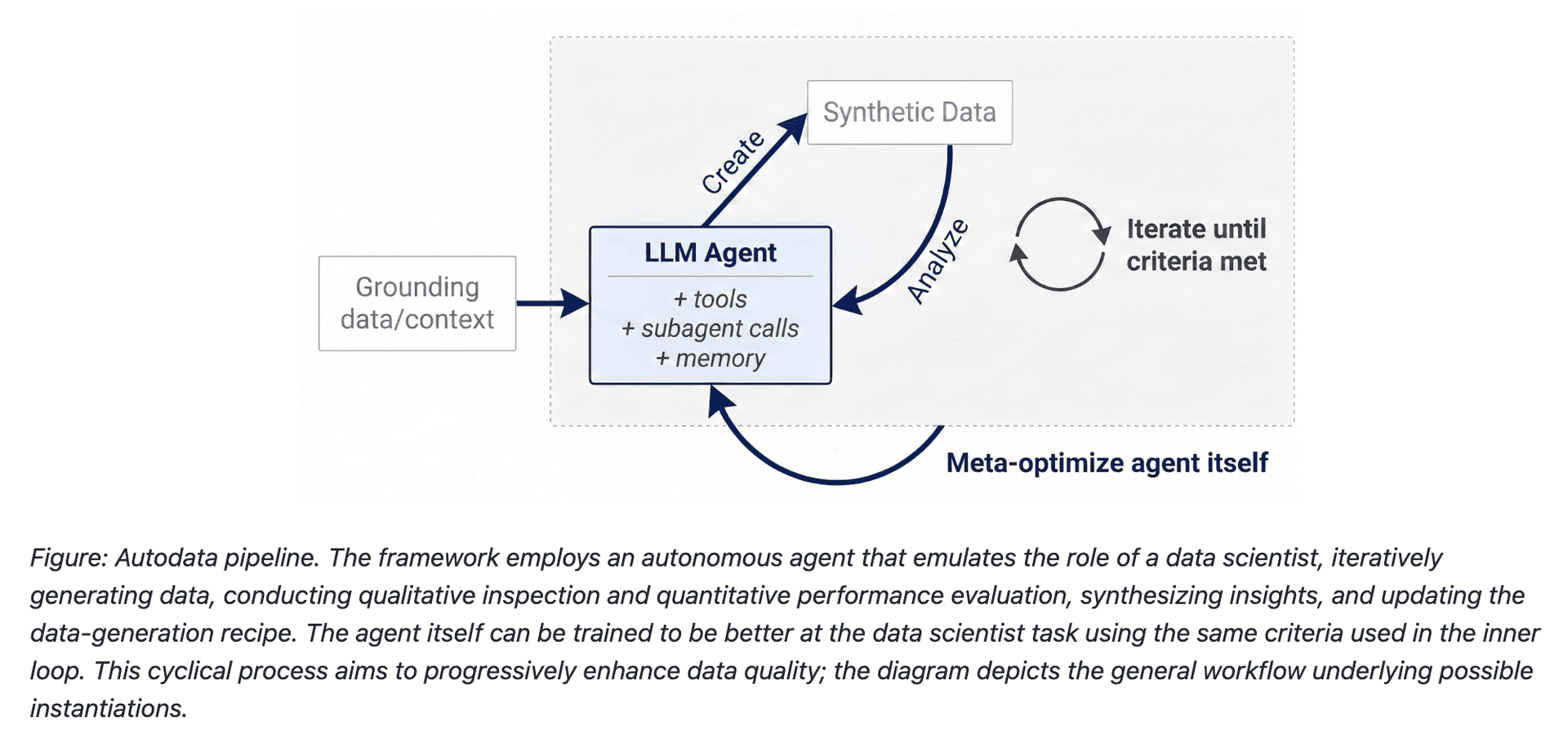
Autodata introduces a revolutionary approach to training data generation by deploying AI agents as autonomous data scientists. Rather than relying on human annotators, the framework orchestrates AI models to independently create, validate, and refine datasets.

  • Autonomous Data Scientists: AI agents work independently to generate and label training data without human intervention, reducing annotation time from weeks to days
  • Quality Validation Pipeline: Built-in verification mechanisms ensure generated data meets strict quality standards before integration into training workflows
  • Agentic Framework Architecture: Multi-agent system coordinates data generation, curation, and validation tasks across distributed environments
  • Scalable Dataset Creation: Framework handles datasets of any size, from thousands to millions of samples, with consistent quality maintenance
  • Domain-Specific Adaptation: Agents learn to generate data tailored to specific problem domains, improving model performance on targeted tasks
  • Iterative Refinement: Continuous feedback loops allow agents to improve data quality based on downstream model performance metrics

Technical Specifications

Autodata operates as a sophisticated multi-agent system designed for enterprise-scale data generation and validation workflows.

  • Agent Architecture: Distributed agentic framework with specialized agents for generation, validation, and curation tasks
  • Integration Compatibility: Seamlessly integrates with existing ML pipelines and popular deep learning frameworks
  • Processing Capacity: Handles datasets ranging from thousands to millions of samples with automated quality assurance
  • Supported Data Types: Generates structured, unstructured, and multimodal training data across vision, NLP, and tabular domains
  • Performance Metrics: Delivers labeled datasets with quality parity to human-annotated data while reducing creation time by 70-80%

Official Benefits

  • 70-80% Faster Data Creation: Autonomous agents generate and label datasets in days rather than weeks, accelerating time-to-model
  • Reduced Annotation Costs: Eliminates expensive human labeling workflows, cutting data preparation expenses by up to 60%
  • Consistent Quality Standards: AI-driven validation ensures uniform data quality across entire datasets, improving model reliability
  • Scalability Without Bottlenecks: Creates datasets of any size without proportional increases in human resources or timeline
  • Improved Model Performance: High-quality synthetic and augmented data leads to 5-15% improvements in downstream model accuracy

Real-World Translation

What Each Feature Actually Means:

  • Autonomous Data Scientists: Instead of hiring teams of annotators to manually label 100,000 images for a computer vision model, Autodata's agents complete the same task automatically in 48 hours, freeing your team to focus on model architecture and evaluation
  • Quality Validation Pipeline: When generating synthetic medical imaging data, the framework automatically verifies that generated samples match real-world distributions and clinical requirements before your researchers ever see them
  • Agentic Framework Architecture: A data scientist working on NLP tasks can deploy multiple specialized agents simultaneously—one generating text variations, another validating semantic accuracy, a third ensuring diversity—all coordinating without manual orchestration
  • Scalable Dataset Creation: A startup building a recommendation system can grow from 10,000 training samples to 5 million without hiring additional annotators or extending timelines
  • Domain-Specific Adaptation: The framework learns that autonomous vehicle datasets need specific edge cases (night driving, rain, pedestrians), automatically prioritizing these scenarios in generated data

Before vs After

Before

Data preparation consumed 60-70% of AI project timelines, with teams manually annotating thousands of samples. Human annotators introduced inconsistencies, quality varied based on fatigue and expertise, and scaling required proportional increases in headcount and budget. Projects frequently stalled waiting for labeled data.

After

Autodata agents autonomously generate, label, and validate datasets while maintaining consistent quality standards. Teams receive production-ready datasets in days rather than weeks, with quality metrics tracked automatically. Scaling to larger datasets requires no additional human resources, just computational infrastructure.

📈 Expected Impact: Organizations can reduce data preparation timelines by 70-80% while simultaneously improving dataset quality and reducing annotation costs by up to 60%.

Job Relevance Analysis

Data Scientist

HIGH Impact
  • Use Case: Data scientists use Autodata to automatically generate training datasets for model development, eliminating weeks spent on manual data annotation and allowing focus on feature engineering and model optimization
  • Key Benefit: Accelerates model development cycles by 3-5x, enabling rapid experimentation with different architectures and hyperparameters without waiting for labeled data
  • Workflow Integration: Integrates directly into ML pipelines as an upstream data generation step, automatically feeding validated datasets into training workflows
  • Skill Development: Requires understanding of agent configuration, quality metrics definition, and validation criteria—shifting focus from annotation management to data science strategy
  • Time Savings: Reclaims 40-50% of project time previously spent on data preparation, redirecting effort toward model improvement and business impact
Data Scientist

Understand business insights via AI for analyzing, predicting, data mining, data visualization, and data warehousing.

4,480 Tools
Data Scientist

AI Researcher

HIGH Impact
  • Use Case: AI researchers leverage Autodata to rapidly generate diverse datasets for testing new architectures, evaluation methodologies, and domain adaptation techniques without manual annotation overhead
  • Key Benefit: Enables faster experimentation cycles and larger-scale studies by removing data availability as a research bottleneck
  • Workflow Integration: Fits into research pipelines as an automated data generation component, allowing researchers to focus on algorithmic innovation rather than dataset curation
  • Skill Development: Deepens understanding of synthetic data generation, agent-based systems, and quality assurance mechanisms in AI workflows
  • Research Acceleration: Supports hypothesis testing at scale by generating multiple dataset variants automatically, enabling more rigorous comparative studies
AI Researcher

Advance innovation with AI tools for academic research, data analysis, knowledge representation, decision-making, and AI-powered chatbots.

6,692 Tools
AI Researcher

3D Modeler

MEDIUM Impact
  • Use Case: 3D modelers use Autodata to generate synthetic 3D training data and variations of existing models for computer vision tasks, augmenting hand-crafted datasets with automatically generated variations
  • Key Benefit: Reduces manual modeling workload by automatically generating dataset variations, lighting conditions, and viewing angles from base models
  • Workflow Integration: Complements existing 3D asset pipelines by automatically creating training data variants from completed models without additional manual work
  • Skill Development: Requires understanding how synthetic 3D data impacts model training and learning to configure generation parameters for specific vision tasks
  • Productivity Gain: Reduces time spent creating dataset variations by 50-70%, allowing focus on high-quality base model creation
3D Modeler

Create beautiful 3D renders in minutes with AI tools for 3D design, characters, animation, and VR.

2,644 Tools
3D Modeler

Getting Started

How to Access

  • Meta AI Research: Access Autodata through Meta's AI research portal or request early access through official Meta AI channels
  • Documentation Review: Study the framework documentation and architecture guides to understand agent configuration and integration requirements
  • Environment Setup: Configure your ML infrastructure to support the distributed agent system and integrate with existing data pipelines
  • Initial Deployment: Start with a pilot project using a smaller dataset to validate quality outputs before scaling to production workflows

Quick Start Guide

For Beginners:

  1. Access the Autodata documentation and review example configurations for your data type (vision, NLP, or tabular)
  2. Define your dataset requirements including size, domain specifics, and quality metrics you want the agents to maintain
  3. Deploy a test run on a small subset (1,000-5,000 samples) to validate output quality against your standards
  4. Review generated data, adjust agent parameters based on results, then scale to full dataset generation

For Power Users:

  1. Configure specialized agents for your specific domain, defining custom validation rules and quality thresholds aligned with downstream model requirements
  2. Integrate Autodata directly into your CI/CD pipeline to automatically generate fresh training data on scheduled intervals or triggered by model performance degradation
  3. Implement custom feedback loops that feed model performance metrics back to Autodata agents, enabling continuous improvement of generated data quality
  4. Deploy multi-agent configurations with specialized roles for generation, validation, and curation, optimizing for your specific data distribution and use case
  5. Monitor agent performance metrics and adjust parameters based on downstream model accuracy improvements and data quality indicators

Pro Tips

  • Start Small: Begin with a limited dataset and specific domain to establish quality baselines before scaling to larger, more complex generation tasks
  • Define Quality Metrics: Clearly specify validation criteria upfront—agents perform better when quality expectations are explicitly defined rather than implicit
  • Monitor Downstream Impact: Track how generated data affects your model's real-world performance; use these insights to continuously refine agent parameters
  • Combine with Human Review: For critical applications, implement spot-check validation where humans review 5-10% of generated data to catch systematic issues early

FAQ

Related Topics

Meta AutodataAI data generationautonomous data scientiststraining data automation

Table of contents

What's New in Meta AutodataTechnical SpecificationsOfficial BenefitsReal-World TranslationJob Relevance AnalysisGetting StartedFAQ
Impact LevelHIGH
Update ReleasedMay 1, 2026

Best for

Data ScientistAI Researcher3D Modeler

Related Use Cases

AI Travel ToolsAI Automation ToolsAI Analytics Tools

Related Articles

AWS Managed Agents Review: OpenAI Partnership
Glean AI Search Review: Enterprise Search Redefined
ChatGPT Security Update: Advanced Protection Features
All AI Spotlights

Editor's Pick Articles

Claude Personal App Connectors Review
ChatGPT Images 2.0 Review: Better Text & Details
Google Gemini Mac App Review: AI Assistant
All Articles
Special offer for AI Owners – 50% OFF Promotional Plans

Join Our Community

Get the earliest access to hand-picked content weekly for free.

Spam-free guaranteed! Only insights.

Follow Us on Socials

Don't Miss AI Topics

ai art generatorai voice generatorai text generatorai avatar generatorai designai writing assistantai audio generatorai content generatorai dubbingai graphic designai banner generatorai in dropshipping

AI Spotlights

Unleashing Today's trailblazer, this week's game-changers, and this month's legends in AI. Dive in and discover tools that matter.

All AI Spotlights
AWS Managed Agents Review: OpenAI Partnership

AWS Managed Agents Review: OpenAI Partnership

Glean AI Search Review: Enterprise Search Redefined

Glean AI Search Review: Enterprise Search Redefined

ChatGPT Security Update: Advanced Protection Features

ChatGPT Security Update: Advanced Protection Features

Mistral's Cloud Code Platform Review

Mistral's Cloud Code Platform Review

Gemini API Webhooks: Real-Time AI Automation

Gemini API Webhooks: Real-Time AI Automation

Zyphra TSP: 2.6x Faster AI Training Review

Zyphra TSP: 2.6x Faster AI Training Review

SoundHound OASYS: Self-Learning AI Agent Platform

SoundHound OASYS: Self-Learning AI Agent Platform

Google Home Gemini 3.1: Smarter AI Assistant

Google Home Gemini 3.1: Smarter AI Assistant

Grok Voice Think Fast 1.0 Review: AI Voice

Grok Voice Think Fast 1.0 Review: AI Voice

Vision Banana Review: Google's Instruction-Tuned Image Generator

Vision Banana Review: Google's Instruction-Tuned Image Generator

GitNexus Review: Open-Source Code Knowledge Graph

GitNexus Review: Open-Source Code Knowledge Graph

Qwen3.6-27B Review: Dense Model Outperforms 397B MoE

Qwen3.6-27B Review: Dense Model Outperforms 397B MoE

ChatGPT Workspace Agents: Custom AI Bots for Teams

ChatGPT Workspace Agents: Custom AI Bots for Teams

Google Gemini Enterprise Agent Platform Review

Google Gemini Enterprise Agent Platform Review

Google Workspace Intelligence: AI Office Automation

Google Workspace Intelligence: AI Office Automation

Google Chrome AI Co-Worker: Gemini Auto Browse

Google Chrome AI Co-Worker: Gemini Auto Browse

GPT-5.5 Review: OpenAI's Smarter Coding & Automation Model

GPT-5.5 Review: OpenAI's Smarter Coding & Automation Model

OpenAI Codex with GPT-5.5: AI Coding Revolution

OpenAI Codex with GPT-5.5: AI Coding Revolution

Claude Personal App Connectors Review

Claude Personal App Connectors Review

You Might Like These Latest News

All AI News

Stay informed with the latest AI news, breakthroughs, trends, and updates shaping the future of artificial intelligence.

Microsoft Copilot Hits 20M Paid Users

May 6, 2026
Microsoft Copilot Hits 20M Paid Users

Runway Eyes World Models Beyond AI Video

May 6, 2026
Runway Eyes World Models Beyond AI Video

Microsoft to Exploit New OpenAI Deal

May 6, 2026
Microsoft to Exploit New OpenAI Deal

Legal AI Startup Legora Hits $5.6B Valuation

May 6, 2026
Legal AI Startup Legora Hits $5.6B Valuation

Anthropic Eyes $900B+ Valuation in Major Fundraise

May 6, 2026
Anthropic Eyes $900B+ Valuation in Major Fundraise

Musk Admits xAI Used OpenAI Models to Train Grok

May 6, 2026
Musk Admits xAI Used OpenAI Models to Train Grok

Replit CEO on Cursor deal, Apple fight, and staying independent

May 6, 2026
Replit CEO on Cursor deal, Apple fight, and staying independent

Meta Acquires Robotics Startup for AI Humanoid Push

May 6, 2026
Meta Acquires Robotics Startup for AI Humanoid Push

Oscars Bans AI-Generated Actors and Scripts

May 6, 2026
Oscars Bans AI-Generated Actors and Scripts
Tools of The Day

Tools of The Day

Discover the top AI tools handpicked daily by our editors to help you stay ahead with the latest and most innovative solutions.


10MAR
Adobe Illustrator
Adobe Illustrator
9MAR
Adobe Firefly
Adobe Firefly
8MAR
Adobe Sensei
Adobe Sensei
7MAR
Adobe Photoshop
Adobe Photoshop
6MAR
Adobe Firefly
Adobe Firefly
5MAR
Shap-E
Shap-E
4MAR
Point-E
Point-E

Explore AI Tools of The Day