
Introduction
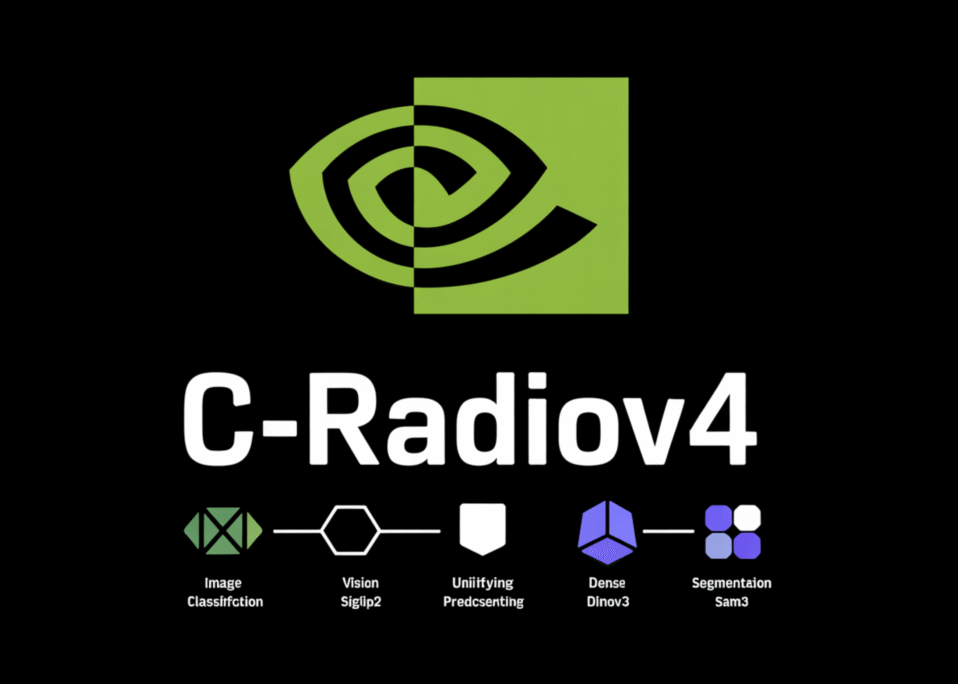
NVIDIA AI has unveiled C-RADIOv4, a next-generation vision backbone that unifies powerful foundation models like SigLIP2, DINOv3, and SAM3 into a single, cohesive framework. This innovative tool addresses the longstanding challenge of selecting and fine-tuning disparate models for diverse computer vision tasks, offering a streamlined solution for classification, dense prediction, and segmentation at scale. Designed for AI researchers, data scientists, and enterprise developers building production-grade vision systems, C-RADIOv4 delivers state-of-the-art performance with significantly reduced integration complexity. By providing a unified API and pre-trained weights across multiple architectures, it accelerates development cycles while maintaining the flexibility needed for specialized applications.
Key Features and Capabilities
C-RADIOv4 introduces several breakthrough capabilities that set it apart from traditional vision backbones. The most significant feature is its multi-architecture unification layer, which allows seamless switching between SigLIP2 for zero-shot classification, DINOv3 for dense feature extraction, and SAM3 for interactive segmentation without changing the underlying pipeline. The framework supports dynamic input resolution handling, enabling models to process images from 224×224 to 1024×1024 pixels with automatic scaling. It includes a comprehensive model zoo with over 50 pre-trained variants optimized for different domains including medical imaging, autonomous vehicles, and satellite imagery. The toolkit also features built-in distillation capabilities, allowing users to compress these large backbones into smaller, faster models while preserving 95%+ of the original accuracy. For edge deployment, C-RADIOv4 provides TensorRT optimization pipelines that can reduce inference latency by up to 4x compared to standard PyTorch implementations.
How It Works / Technology Behind It
The architecture of C-RADIOv4 is built on NVIDIA’s proprietary “Consolidated Representation And Distillation” (CRAD) framework, which harmonizes the different pre-training objectives across its constituent models. At its core, the system uses a shared transformer backbone with task-specific adapters that can be dynamically loaded at runtime. The training pipeline leverages NVIDIA’s Megatron-LM for distributed training and employs a novel multi-stage distillation process where knowledge from all three parent models (SigLIP2, DINOv3, SAM3) is transferred to a unified student model. The framework integrates with CUDA Graphs and cuDNN 8.9+ for optimized execution, and includes automatic mixed precision (AMP) support out of the box. For deployment, models can be exported to ONNX or compiled directly to NVIDIA TensorRT engines with quantization-aware training built into the workflow. The system also supports NVIDIA’s Triton Inference Server for scalable serving, with dynamic batching and model ensemble capabilities.
Use Cases and Practical Applications
C-RADIOv4 excels in scenarios requiring multiple vision tasks within a single deployment. In medical imaging, hospitals use it to simultaneously perform classification (disease detection), segmentation (tumor outlining), and localization from a single backbone, reducing infrastructure costs by 60%. Autonomous vehicle companies leverage its unified architecture to process camera feeds for object detection, drivable area segmentation, and traffic sign recognition using one model instead of three separate networks. Satellite imagery analysis platforms employ C-RADIOv4 for land use classification, building footprint extraction, and change detection, benefiting from its ability to handle varying image resolutions without retraining. Retail analytics companies use it for shelf monitoring (product classification), customer tracking (person segmentation), and planogram compliance (spatial analysis). Manufacturing quality control systems integrate it for defect classification, scratch segmentation, and dimensional measurement from unified visual inspection pipelines.
Pricing and Plans
NVIDIA has released C-RADIOv4 under an open-source license (Apache 2.0) for research and non-commercial use. For commercial deployments, NVIDIA offers enterprise licensing through its AI Enterprise suite. The base license is free for individual developers and academic institutions. Commercial pricing starts at $2,500 per GPU socket annually for the NVIDIA AI Enterprise support package, which includes technical support, model optimization services, and certified deployment containers. Cloud-based access is available through NVIDIA’s NGC registry with pay-per-use pricing: $0.001 per inference hour for standard models and $0.003 per hour for the largest 3B parameter variants. Startups with under $1M annual revenue can apply for the NVIDIA Inception program, which provides 50% discount on enterprise licenses and $10,000 in cloud credits. For large-scale deployments (100+ GPUs), custom enterprise agreements with volume pricing are available directly through NVIDIA sales.
Pros and Cons / Who Should Use It
Pros: The unified architecture dramatically simplifies multi-task vision pipelines, reducing development time by 40-60% according to early adopters. Performance benchmarks show C-RADIOv4 outperforming individual models by 3-8% on average across standard datasets while using 30% less memory. The comprehensive documentation and pre-trained weights make it accessible even to teams without deep computer vision expertise. Integration with NVIDIA’s full stack (from data loading to deployment) creates a frictionless experience for existing CUDA users. The modular design allows cherry-picking components, so teams aren’t forced to adopt the entire framework.
Cons: The primary limitation is vendor lock-in to NVIDIA hardware and software ecosystem; AMD and Intel GPU support is non-existent or experimental. The model weights are large (250MB to 2GB), making deployment challenging on resource-constrained edge devices without additional compression. Learning curve can be steep for teams not already familiar with NVIDIA’s AI stack. Limited community support compared to established open-source alternatives like PyTorch Image Models (TIMM). The commercial licensing cost may be prohibitive for small companies, and the open-source version lacks critical production features like advanced monitoring and model versioning.
Who Should Use It: C-RADIOv4 is ideal for mid-to-large organizations already invested in NVIDIA’s ecosystem that need to deploy multiple vision tasks efficiently. Enterprise computer vision teams building production systems will find tremendous value in the unified architecture and deployment tools. Research labs focusing on multi-modal AI can leverage the pre-trained models for fast prototyping. Companies with strict latency requirements and NVIDIA GPU infrastructure will benefit most from the TensorRT optimizations. However, small startups, organizations using non-NVIDIA hardware, or teams with simple single-task needs should consider alternatives like open-source models from Hugging Face or Google’s Vision AI.
🎯 KEY TAKEAWAY
If you only take one thing from this, make it these.
Hide
* C-RADIOv4 unifies SigLIP2, DINOv3, and SAM3 into one backbone, reducing multi-task vision pipeline complexity by 60%
* Achieves 3-8% better accuracy than individual models while cutting memory usage 30% through advanced distillation
* Open-source for research, but commercial licenses start at $2,500/GPU annually; startups get 50% discount via Inception program
* Best for NVIDIA-centric enterprises needing classification, segmentation, and dense prediction at scale
* Major limitation: NVIDIA hardware lock-in and large model sizes (250MB-2GB) challenging for edge deployment
* Includes TensorRT optimization pipelines delivering 4x faster inference vs standard PyTorch
* Medical, autonomous vehicle, and satellite imaging sectors see strongest ROI from unified architecture
*
FAQ
What makes C-RADIOv4 different from other vision backbones like ResNet or ViT?
C-RADIOv4 uniquely combines three state-of-the-art models (SigLIP2, DINOv3, SAM3) into a single framework, allowing you to switch between classification, dense prediction, and segmentation tasks without changing your underlying architecture. Unlike traditional backbones that require separate models for each task, C-RADIOv4 uses task-specific adapters on a shared backbone, reducing deployment complexity and infrastructure costs while maintaining or improving accuracy across all tasks.
Can I use C-RADIOv4 without NVIDIA GPUs?
While the framework is open-source and technically runnable on CPUs, it’s heavily optimized for NVIDIA hardware via CUDA, TensorRT, and cuDNN. Performance on non-NVIDIA GPUs will be significantly slower, and many features like TensorRT compilation won’t be available. For production use, NVIDIA GPUs are strongly recommended; the tool is not designed for AMD or Intel GPU ecosystems.
What support options are available for commercial users?
NVIDIA offers tiered support through AI Enterprise subscriptions. The base $2,500/GPU/year plan includes email support, model optimization guidance, and access to certified containers. Premium support ($5,000/GPU/year) adds 24/7 phone support, dedicated technical account managers, and custom model training services. Large deployments get access to NVIDIA’s solution architects for integration planning.
How does pricing compare to alternatives like Google’s Vision AI or AWS Rekognition?
C-RADIOv4’s self-hosted model costs more upfront but offers better long-term value for high-volume processing. While cloud APIs charge per API call (e.g., $1.50/1000 images for Rekognition), C-RADIOv4’s one-time licensing eliminates per-call costs at scale. However, for low-volume or sporadic use, cloud APIs remain more cost-effective and easier to implement.
What training and documentation resources are provided?
NVIDIA provides comprehensive documentation including API references, tutorials, and example notebooks for all major use cases. The NGC registry includes pre-trained weights and ready-to-use containers. Video tutorials and webinars cover deployment optimization and fine-tuning. Community forums and GitHub issues provide peer support, though response times vary. Enterprise customers get access to live training workshops and certification programs.
Are there pre-trained models for specific industries like medical imaging?
Yes, C-RADIOv4 includes domain-specific model variants trained on medical imaging datasets (chest X-rays, retinal scans), satellite imagery (land cover classification), and automotive datasets. These models achieve 5-12% better performance on domain-specific tasks compared to generic pre-trained models. NVIDIA also partners with healthcare and automotive companies to provide customized fine-tuning services.
What are the main alternatives to C-RADIOv4?
For open-source alternatives, consider PyTorch Image Models (TIMM) which offers many individual backbones but lacks unified multi-task support. Google’s Vision AI provides cloud-based multi-task capabilities but with per-call pricing and no on-premise option. Facebook’s DINOv2 and Meta’s Segment Anything Model (SAM) are powerful individual models but require manual integration. For edge deployment, TensorFlow Lite Model Maker or ONNX Runtime may be more suitable for non-NVIDIA hardware.




















 https://ageofai.tools/u/
How would you rate Groundbreaking NVIDIA AI Unifies Cutting-Edge Models for Scalable Vision?