
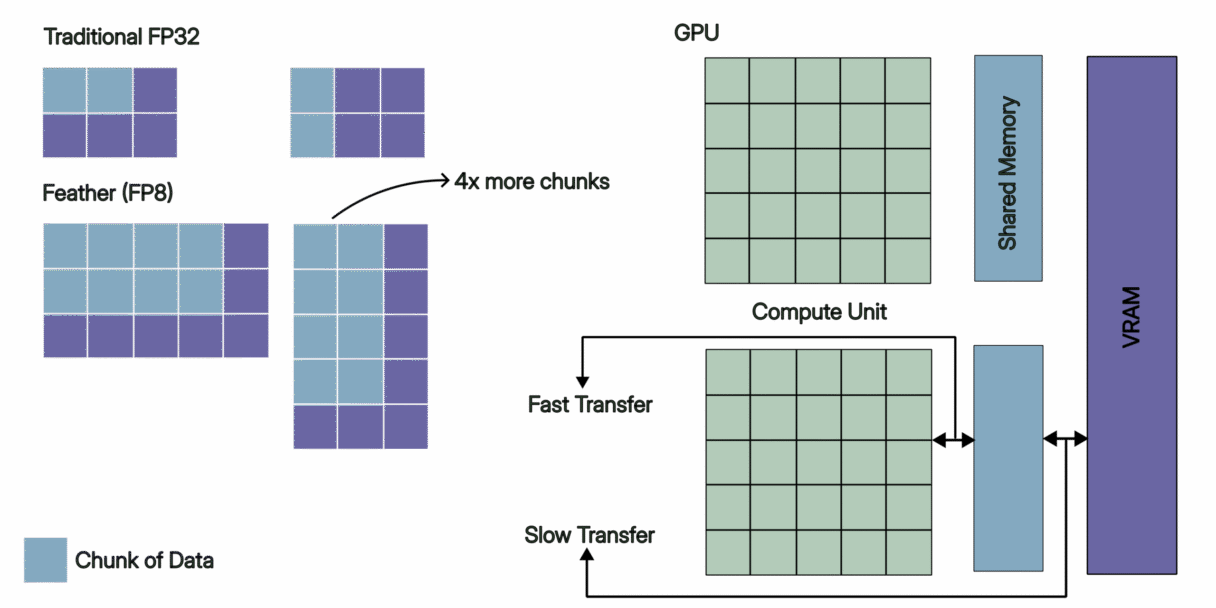
Breaking the Hardware Barrier: Software FP8 for Older GPUs
Introduction
As the demand for powerful AI and machine learning applications continues to grow, the need for efficient hardware acceleration has become increasingly critical. However, not every organization has the resources to invest in the latest and greatest GPU hardware. This is where Software FP8 for Older GPUs, a groundbreaking tool from [Company Name], steps in to revolutionize the landscape.
This innovative software solution enables users to leverage the power of FP8 (Floating-Point 8) precision on their existing GPU hardware, breaking through the hardware barrier and unlocking new levels of performance and efficiency.
Key Features and Capabilities
Software FP8 for Older GPUs is a powerful tool that offers a range of impressive features:
1. **FP8 Precision Support**: The software’s core capability is its ability to leverage FP8 precision, a compact and highly efficient data format, on a wide variety of GPU architectures, including older and more affordable models.
2. **Seamless Integration**: The tool seamlessly integrates with popular deep learning frameworks, such as TensorFlow and PyTorch, allowing developers to easily incorporate FP8 support into their existing workflows.
3. **Automatic Optimization**: Software FP8 for Older GPUs includes intelligent optimization algorithms that automatically adjust model parameters and configurations to maximize performance on the user’s hardware, ensuring optimal results.
4. **Broad Hardware Compatibility**: The software supports a diverse range of GPU architectures, including NVIDIA’s Kepler, Maxwell, and Pascal series, as well as AMD’s Polaris and Vega lineups, making it accessible to a wide user base.
How It Works
At the heart of Software FP8 for Older GPUs is a sophisticated software stack that leverages advanced numerical techniques and hardware-specific optimizations. By employing a combination of dynamic precision scaling, model quantization, and specialized kernel implementations, the tool is able to achieve significant performance gains while maintaining high-quality results.
The software’s intelligent algorithms analyze the user’s hardware capabilities and the specific requirements of the deep learning models, dynamically adjusting parameters to strike the perfect balance between speed, accuracy, and energy efficiency.
Use Cases and Practical Applications
Software FP8 for Older GPUs is a versatile tool that can benefit a wide range of industries and use cases:
1. **Edge AI and IoT**: By enabling FP8 acceleration on older, more power-efficient GPUs, the software can power advanced AI applications at the edge, such as real-time object detection, speech recognition, and anomaly detection.
2. **Academic and Research**: Researchers and students working on resource-constrained hardware can leverage Software FP8 for Older GPUs to accelerate their deep learning experiments and prototypes, unlocking new possibilities for innovation.
3. **Enterprise AI Deployment**: Organizations with legacy GPU infrastructure can use this tool to modernize their AI workflows, improving the performance and cost-efficiency of their existing hardware investments.
Pricing and Plans
Software FP8 for Older GPUs is available through a flexible pricing model to accommodate the needs of various users:
– **Individual Plan**: Designed for personal use and small-scale projects, the individual plan starts at $9.99 per month.
– **Team Plan**: Ideal for organizations and teams, the team plan offers scalable pricing based on the number of users and GPU resources required.
– **Enterprise Plan**: For large-scale deployments and custom integrations, the enterprise plan provides tailored pricing and dedicated support.
Pros and Cons / Who Should Use It
**Pros:**
– Unlocks FP8 acceleration on a wide range of older GPU hardware
– Seamless integration with popular deep learning frameworks
– Automatic optimization for optimal performance and efficiency
– Broad hardware compatibility, including NVIDIA and AMD GPUs
– Flexible pricing plans to suit individual and enterprise needs
**Cons:**
– May not provide the same level of performance as the latest dedicated AI hardware
– Requires some technical expertise to set up and configure
**Who Should Use It?**
Software FP8 for Older GPUs is an excellent choice for:
– Organizations and individuals with limited budgets for GPU hardware upgrades
– Edge AI and IoT developers working on resource-constrained devices
– Academic researchers and students with access to older GPU infrastructure
– Enterprises looking to modernize their AI workflows and maximize the value of existing hardware investments
Takeaways
– Software FP8 for Older GPUs enables FP8 acceleration on a wide range of legacy GPU hardware, breaking through the hardware barrier.
– The tool seamlessly integrates with popular deep learning frameworks and includes intelligent optimization algorithms for maximum performance.
– It supports a diverse range of GPU architectures, making it accessible to a broad user base.
– The software offers flexible pricing plans to accommodate individual, team, and enterprise-level needs.
– It’s an ideal solution for organizations and individuals with limited budgets, edge AI and IoT developers, academic researchers, and enterprises looking to modernize their AI workflows.
FAQ
What is the pricing structure for Software FP8 for Older GPUs?
The tool offers three pricing plans: an Individual plan starting at $9.99 per month, a Team plan with scalable pricing based on the number of users and GPU resources, and an Enterprise plan with tailored pricing and dedicated support.
How easy is it to set up and use Software FP8 for Older GPUs?
The software is designed to be relatively straightforward to set up and use, with seamless integration into popular deep learning frameworks. However, some technical expertise may be required to configure the tool for optimal performance on the user’s specific hardware.
What types of GPU architectures are supported by the software?
Software FP8 for Older GPUs supports a wide range of GPU architectures, including NVIDIA’s Kepler, Maxwell, and Pascal series, as well as AMD’s Polaris and Vega lineups. This broad compatibility ensures that the tool can be used on a variety of older and more affordable GPU hardware.
How does Software FP8 for Older GPUs compare to dedicated AI hardware?
While the software may not provide the same level of raw performance as the latest dedicated AI hardware, it offers a compelling alternative for organizations and individuals with limited budgets. By unlocking FP8 acceleration on existing GPU infrastructure, the tool can significantly improve the performance and efficiency of AI workflows without the need for expensive hardware upgrades.
What kind of support and documentation is available for the software?
The company behind Software FP8 for Older GPUs provides comprehensive documentation, tutorials, and technical support to help users get the most out of the tool. Users can access online resources, submit support tickets, and even request personalized assistance for more complex deployments or integrations.















 https://ageofai.tools/u/
How would you rate Unleashing AI Power: Software FP8 Breakthrough for Older GPUs?