
Introducing aiclient-llm: One Python Client for All Your LLMs
Introduction
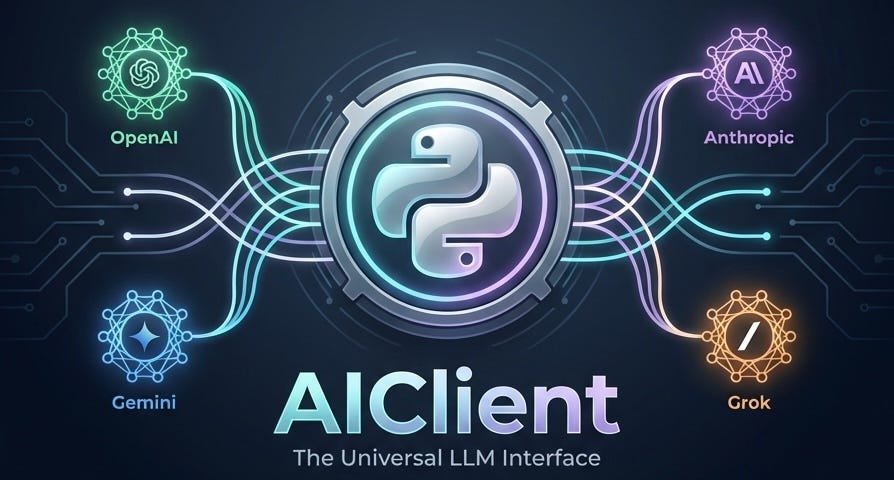
Navigating the ever-expanding landscape of Large Language Models (LLMs) can be a daunting task for developers and researchers. Introducing aiclient-llm, a powerful Python library that simplifies the process of interacting with multiple LLM providers from a single, unified interface. This tool aims to streamline your AI development workflow, allowing you to focus on building innovative applications rather than grappling with the complexities of individual LLM APIs.
Key Features and Capabilities
aiclient-llm boasts an impressive array of features that set it apart from the competition. At its core, the library provides a consistent and intuitive API for interacting with a wide range of LLM providers, including OpenAI, Anthropic, Hugging Face, and more. This means you can easily switch between different LLMs without having to rewrite your code, saving you time and effort.
Beyond the basic text generation capabilities, aiclient-llm also supports advanced features such as text summarization, sentiment analysis, and named entity recognition. These powerful capabilities can be leveraged to build a wide range of AI-powered applications, from chatbots and content creation tools to sentiment analysis and knowledge extraction systems.
How It Works / Technology Behind It
Under the hood, aiclient-llm utilizes a modular and extensible architecture, allowing you to easily add support for new LLM providers as they emerge. The library abstracts away the complexities of the underlying APIs, providing a unified interface that simplifies the development process.
aiclient-llm is built on top of the popular Hugging Face Transformers library, ensuring that it benefits from the latest advancements in natural language processing. The library also supports seamless integration with other popular Python data science and machine learning libraries, such as Pandas and scikit-learn, making it a versatile tool for a wide range of AI and NLP applications.
Use Cases and Practical Applications
The versatility of aiclient-llm makes it a valuable tool for a diverse range of use cases. Developers working on chatbots and conversational AI can leverage the library’s text generation capabilities to create more natural and engaging interactions. Content creators can use aiclient-llm for tasks like article summarization, sentiment analysis, and topic extraction, streamlining their workflow and improving content quality.
Researchers and data scientists can also benefit from aiclient-llm, using it to quickly prototype and experiment with different LLM models for a variety of NLP tasks, such as text classification, named entity recognition, and knowledge extraction. The library’s flexibility and ease of use make it an excellent choice for both novice and experienced AI practitioners.
Pricing and Plans
aiclient-llm is an open-source library, freely available for developers to use and contribute to. The library is licensed under the MIT license, allowing for commercial use, modification, and distribution. While there are no paid plans or subscription models associated with aiclient-llm, users may need to pay for the underlying LLM services they choose to use, depending on the provider’s pricing structure.
Pros and Cons / Who Should Use It
**Pros:**
– Unified interface for interacting with multiple LLM providers
– Supports advanced NLP capabilities like text summarization and sentiment analysis
– Integrates seamlessly with popular Python data science and machine learning libraries
– Open-source and MIT-licensed, allowing for commercial use and customization
– Actively maintained and supported by a community of developers
**Cons:**
– Users still need to manage and pay for the underlying LLM services they use
– May not offer the same level of customization and control as directly using the LLM provider’s API
– Dependent on the availability and reliability of the connected LLM services
aiclient-llm is an excellent choice for developers, researchers, and AI practitioners who want to streamline their LLM-based projects and experiments. Whether you’re building chatbots, content analysis tools, or conducting NLP research, aiclient-llm can help you focus on your core objectives without getting bogged down in the complexities of individual LLM APIs.
Takeaways
– aiclient-llm provides a unified interface for interacting with multiple LLM providers, simplifying your AI development workflow
– The library supports advanced NLP capabilities like text summarization and sentiment analysis, enabling a wide range of practical applications
– aiclient-llm is open-source and MIT-licensed, allowing for commercial use and customization
– While users still need to manage and pay for the underlying LLM services, aiclient-llm can help you focus on your core objectives
– aiclient-llm is an excellent choice for developers, researchers, and AI practitioners working with LLMs across a variety of use cases
FAQ
What LLM providers does aiclient-llm support?
aiclient-llm currently supports integration with OpenAI, Anthropic, and Hugging Face LLM models. The library is designed to be extensible, allowing for easy addition of support for new LLM providers as they emerge.
Is aiclient-llm free to use?
Yes, aiclient-llm is an open-source library licensed under the MIT license, which allows for free commercial use, modification, and distribution. However, users will still need to pay for the underlying LLM services they choose to use, depending on the provider’s pricing structure.
How difficult is it to set up and use aiclient-llm?
aiclient-llm is designed to be user-friendly and easy to set up. The library provides clear documentation and examples, making it accessible for both novice and experienced AI practitioners. The unified API and seamless integration with popular Python libraries also help to minimize the learning curve.
Does aiclient-llm offer any support or community resources?
As an open-source project, aiclient-llm is supported by a community of developers. The project’s GitHub repository includes detailed documentation, tutorials, and a forum for users to ask questions and share their experiences. The maintainers of the library are also responsive to issues and pull requests, ensuring ongoing support and improvement.
How does aiclient-llm compare to using the LLM provider’s API directly?
While using the LLM provider’s API directly offers more customization and control, aiclient-llm provides a significant convenience factor by abstracting away the complexities of the underlying APIs. This can save developers time and effort, especially when working with multiple LLM providers. The trade-off is that aiclient-llm may not offer the same level of granular control as the provider’s API.




















 https://ageofai.tools/u/
How would you rate Unleash the Power of LLMs: One Python Client to Rule Them All?