
*takeaways
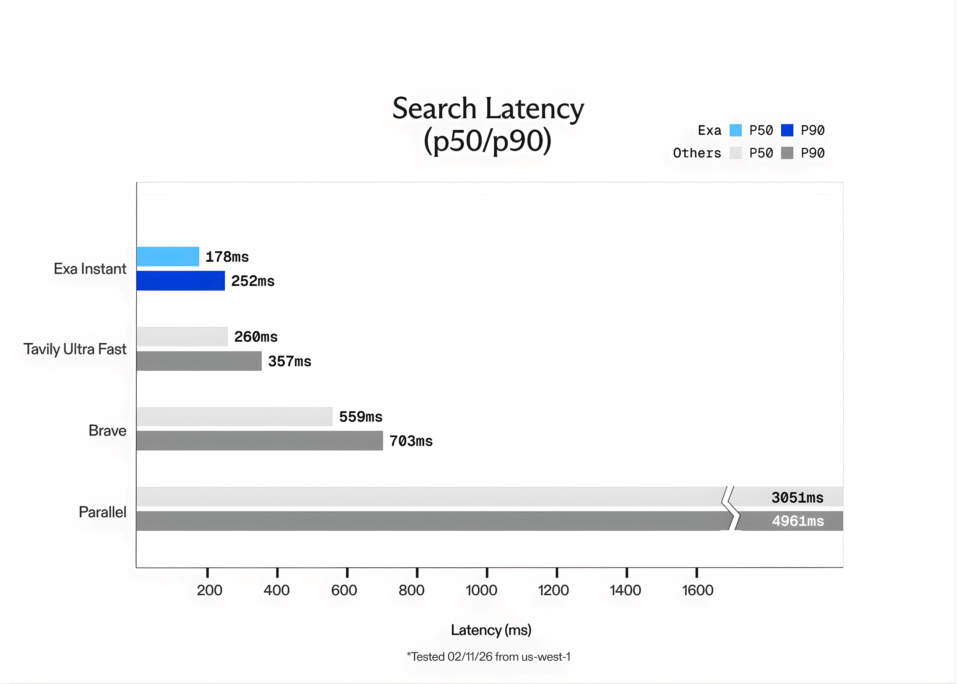
– Exa Instant is a neural search engine that delivers results in under 200ms, designed specifically for real-time agentic workflows and RAG systems.
– Its key advantage is combining the deep semantic understanding of LLMs with the low latency required for interactive AI applications.
– Ideal for developers building real-time AI assistants, automated research agents, and dynamic content discovery platforms.
– Pricing follows a freemium model with pay-as-you-go options, making it accessible for both individual developers and large enterprises.
– While it offers a significant speed advantage, users must consider the cost at scale and its reliance on Exa’s web index.
*takeaways
Exa AI Introduces Exa Instant: A Sub-200ms Neural Search Engine Designed to Eliminate Bottlenecks for Real-Time Agentic Workflows
Artificial intelligence search tools are evolving rapidly, and the latest breakthrough comes from Exa AI. The company has introduced Exa Instant, a neural search engine designed to deliver results in under 200 milliseconds. This speed is a critical development for developers and businesses building real-time agentic workflows, where delays can break the user experience. By eliminating the latency bottleneck typically associated with deep semantic search, Exa Instant aims to make AI agents more responsive and capable of handling complex, time-sensitive tasks.
Exa Instant is specifically designed for AI engineers, developers, and product teams working on autonomous agents, retrieval-augmented generation (RAG) systems, and real-time data analysis. The core promise is simple yet powerful: instant access to the world’s knowledge without the wait. For applications that require immediate decision-making based on the latest information—such as financial trading bots, customer support agents, or live research assistants—this speed is a game-changer. It bridges the gap between the need for high-quality, neural search results and the low-latency requirements of modern interactive applications.
Key Features and Capabilities
Exa Instant is built around a few core capabilities that set it apart from traditional search APIs. The primary feature is its incredible speed, consistently delivering neural search results in under 200ms. This is achieved through a highly optimized infrastructure that doesn’t sacrifice the quality of understanding that neural search provides. Unlike keyword-based search engines, Exa’s models understand the semantic meaning and context of queries, allowing them to retrieve highly relevant information even for complex or conversational questions.
Another key capability is its focus on structured data and web content. Exa Instant is not just a web crawler; it’s a sophisticated system that can understand and index a vast corpus of information, making it suitable for a wide range of applications. For developers, this means you can integrate a powerful search function into your application with a simple API call. The tool is designed to handle high-throughput demands, making it scalable for applications that serve thousands of concurrent users. Its ability to provide fast, relevant results makes it an ideal backend for AI agents that need to “look up” information on the fly to complete a task or answer a user query accurately.
How It Works / Technology Behind It
The technology behind Exa Instant is a departure from traditional search engine architectures. While conventional search relies heavily on keyword matching and inverted indexes, Exa uses a neural approach. This involves training large language models (LLMs) to understand the semantic relationship between a query and a document. When a user submits a query, the system doesn’t just look for matching keywords; it converts the query into a dense vector representation (an embedding) and searches for documents with similar vector representations in its index.
This vector-based search allows for a much deeper level of understanding. For example, a query like “companies developing sustainable battery technology” would not only find pages with those exact words but also pages discussing specific firms, their innovations in lithium-ion alternatives, or their patents in solid-state batteries, even if the exact phrasing differs. Exa Instant’s innovation lies in optimizing this entire pipeline—from embedding the query to scanning the vector database and ranking results—to operate in under 200ms. This involves advanced caching strategies, efficient model inference, and a distributed architecture that minimizes network latency, ensuring the search process is a seamless, near-instantaneous part of an agentic workflow.
Use Cases and Practical Applications
The sub-200ms latency of Exa Instant opens up a new class of real-time applications that were previously difficult or impossible to build.
- Real-Time AI Assistants and Chatbots: Imagine a customer support chatbot that can instantly pull up the latest product documentation, user reviews, or competitor comparisons to answer a customer’s question. With Exa Instant, the “search” part of the conversation feels instantaneous, creating a natural and fluid user experience.
- Automated Research and Reporting: Financial analysts or market researchers can build agents that continuously scan the web for news, earnings reports, and market sentiment. The agent can use Exa Instant to quickly find relevant articles and data points, synthesize them, and generate real-time alerts or summaries without the user experiencing any noticeable delay.
- Dynamic Content Discovery: For content platforms or e-commerce sites, Exa Instant can power recommendation engines that understand user intent beyond simple keywords. A user could ask, “show me articles about ethical AI in healthcare,” and the system would instantly retrieve a curated list of relevant content, improving engagement and discovery.
- Coding and Technical Assistants: Developers can build coding assistants that use Exa Instant to search for solutions, documentation, or code examples from the web in real-time. When a developer asks a technical question, the assistant can provide relevant Stack Overflow threads or GitHub repositories in a fraction of a second, accelerating the problem-solving process.
Pricing and Plans
Exa AI offers a tiered pricing model for Exa Instant, making it accessible for everyone from individual developers to large enterprises. While specific pricing can change, the structure typically includes:
- Free Tier: A generous free plan is often available for developers to experiment with the API. This usually includes a limited number of searches per month, perfect for building prototypes or testing the tool’s capabilities.
- Pay-As-You-Go: For production applications, Exa offers a usage-based pricing model. Costs are typically calculated per 1,000 searches, with different rates for different types of search (e.g., web search vs. specific domain search). This provides flexibility for applications with fluctuating traffic.
- Enterprise Plans: For large-scale deployments, Exa provides custom enterprise plans with dedicated support, higher rate limits, and potential for custom model training or dedicated infrastructure. These plans are designed for organizations that require guaranteed performance and service-level agreements (SLAs).
For the most accurate and up-to-date pricing information, it is always best to visit the official Exa AI website.
Pros and Cons / Who Should Use It
Pros:
- Unmatched Speed: The sub-200ms latency is a significant competitive advantage, enabling real-time applications.
- Semantic Understanding: Provides more relevant results than keyword-based search by understanding context and intent.
- Scalable and Reliable: Built on a modern infrastructure designed for high-throughput, production-grade applications.
- Developer-Friendly: Simple API integration makes it easy for developers to get started.
Cons:
- Cost at Scale: While the free tier is great, heavy usage in a production environment can become costly, and careful monitoring is required.
- Dependence on External Data: The quality of results is dependent on Exa’s web index, which may not cover every niche or private source of information.
FAQ
What is Exa Instant and how is it different from a traditional search API?
Exa Instant is a neural search engine that uses AI to understand the meaning and context of queries, not just keywords. It is designed for extreme speed, delivering results in under 200ms, which makes it ideal for real-time applications like AI agents. Traditional search APIs are often slower and rely on keyword matching, which can be less effective for complex queries.
Who is the ideal user for Exa Instant?
The ideal user is an AI engineer, developer, or product team building applications that require fast, intelligent access to information. This includes developers of AI assistants, RAG systems, automated research tools, and any application where low-latency, high-quality search is a critical component of the user experience.
How does Exa Instant’s pricing work?
Exa Instant offers a freemium model with a free tier for experimentation and a pay-as-you-go plan for production use, billed per 1,000 searches. They also provide custom enterprise plans for high-volume users. For the most current pricing details, you should check the official Exa AI website.
What are the main alternatives to Exa Instant?
Alternatives include other vector search and AI-powered search providers like Weaviate, Pinecone, and Vespa. For developers who need to build their own search system, open-source tools like Elasticsearch or OpenSearch with vector capabilities are also options. However, Exa Instant’s primary competitive advantage is its sub-200ms speed for neural search.
Is Exa Instant easy to integrate and use?
Yes, Exa Instant is designed to be developer-friendly with a simple and well-documented API. Most developers can integrate it into their applications with minimal code. The learning curve is generally low for those familiar with API integrations, and the documentation provides clear examples and guides.
What kind of support and documentation does Exa AI provide?
Exa AI provides comprehensive documentation covering API endpoints, parameters, and code examples in multiple languages. They typically offer community support through forums or chat, and enterprise plans include dedicated support channels for faster response times and personalized assistance.





















 https://ageofai.tools/u/
How would you rate Exa Instant: Groundbreaking Sub-200ms Neural Search for Real-Time Workflows?