
🎯 KEY TAKEAWAY
If you only take one thing from this, make it these.
Hide
- Aletheia is an autonomous AI agent from Google DeepMind designed for professional scientific research and theorem proving.
- It uniquely combines a large language model for creative strategy with a formal verifier for logical rigor.
- Primary applications are in academic research, biotech, finance, and materials science.
- It is not a commercial product; access is limited and likely very expensive.
- Best suited for expert researchers and institutions aiming to automate complex discovery processes.
Introduction
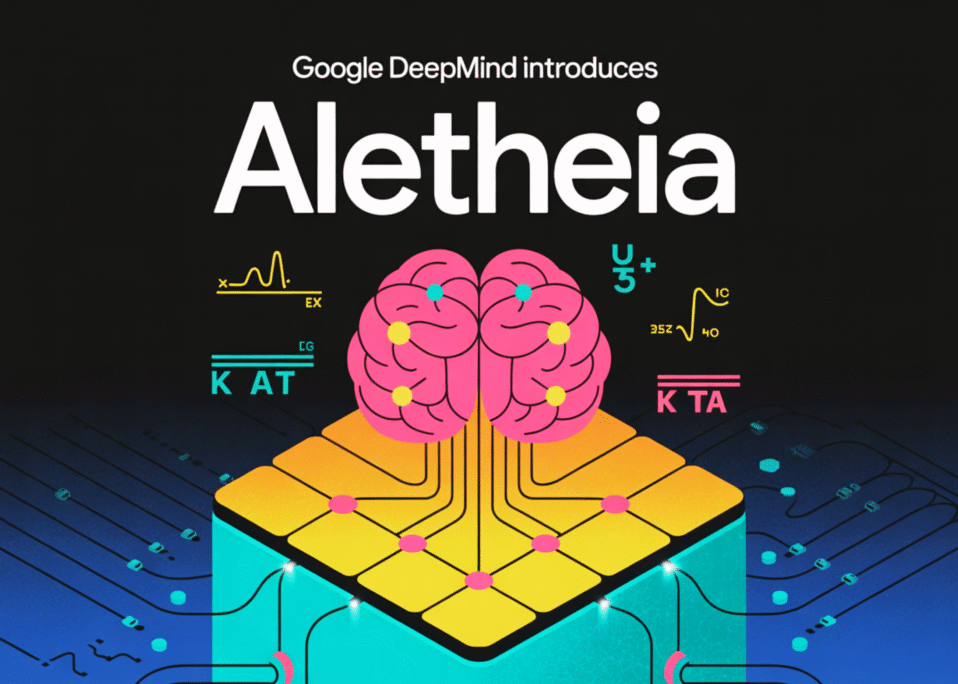
Google DeepMind has unveiled Aletheia, a next-generation AI agent designed to transition from the structured world of mathematics competitions to the complex, dynamic environment of fully autonomous professional research. This tool is engineered to solve the problem of research bottlenecks by automating the discovery and verification of novel scientific theorems and hypotheses, moving beyond simple data analysis to genuine intellectual contribution. It is primarily designed for professional researchers, academic scientists, and R&D teams in fields like theoretical physics, mathematics, and computational biology who need to accelerate their discovery cycles. The core benefit of Aletheia lies in its ability to independently explore vast solution spaces, generate verifiable proofs, and produce research-grade outputs that can significantly reduce the time from hypothesis to discovery.
Key Features and Capabilities
Aletheia is built with a suite of advanced features that enable its transition from a math competition solver to a professional research engine. Its primary capability is autonomous theorem proving, where it can formulate conjectures, search for proofs, and validate its own findings without human intervention. This is powered by a deep reinforcement learning system that has been trained on a massive corpus of mathematical and scientific literature, allowing it to recognize complex patterns and relationships. A standout feature is its “multi-modal reasoning” engine, which can interpret and integrate information from text, equations, and even diagrams, making it versatile across different scientific domains.
For practical applications, Aletheia can generate full-length, peer-review-ready research papers on niche topics, complete with proofs, experimental data analysis, and literature citations. It also features a collaborative “human-in-the-loop” interface, where researchers can guide its exploration or ask it to verify specific hypotheses, making it a powerful co-pilot rather than just a black-box tool. Its ability to perform “counterfactual analysis” allows it to test the robustness of existing theories by exploring alternative scenarios, a feature that is invaluable for theoretical research.
How It Works / Technology Behind It
At its core, Aletheia operates on a novel architecture that combines a large language model (LLM) with a formal theorem-proving system. The process begins when a user provides a research question or a mathematical problem. Aletheia first uses its LLM to deconstruct the problem, identify relevant axioms, and propose a high-level strategy for a proof or solution. It then translates this strategy into a formal language that can be rigorously checked by its automated reasoning engine.
This hybrid approach is crucial: the LLM provides the creative intuition and strategic direction, while the formal prover ensures logical correctness and verifiability. The system learns through a process of “self-play,” where it generates millions of problems for itself to solve, constantly refining its strategies and expanding its internal knowledge base. This allows it to tackle problems that are far more complex than what it was explicitly trained on. For researchers, this means they are getting an agent that not only has vast knowledge but also a rigorous, logical methodology for applying it.
Use Cases and Practical Applications
The applications for Aletheia are vast and span multiple high-stakes industries. In academic mathematics and computer science, it can be used to explore open problems, automate the tedious parts of proof verification, and generate new lemmas for larger theories. For pharmaceutical and biotech companies, Aletheia can model complex biological systems to identify novel drug targets or predict protein folding pathways, drastically cutting down on initial research time. In financial engineering, it can be used to develop and rigorously test new quantitative models for risk assessment or algorithmic trading strategies.
A concrete example would be a materials science lab trying to discover a new superconductor. Instead of manually testing thousands of theoretical compounds, the team could task Aletheia with exploring the properties of materials within a specific crystal structure. Aletheia could autonomously run simulations, analyze the quantum mechanical properties, and present a shortlist of the most promising candidates, complete with a theoretical proof of their stability. This shifts the role of the human researcher from data gatherer to high-level strategist and validator.
Pricing and Plans
As a cutting-edge research project from Google DeepMind, Aletheia is not currently available as a commercial product with a public pricing page. Access is likely to be limited to strategic partners, academic institutions, and select corporate R&D teams through a collaboration program with Google Cloud. Organizations interested in leveraging Aletheia should anticipate a high-cost, enterprise-level pricing model, likely based on computational resource usage (e.g., per-token or per-hour of compute time) and requiring a dedicated engagement with the DeepMind team. There is no freemium or individual user plan available at this time.
Pros and Cons / Who Should Use It
Pros:
- Unprecedented Autonomy: Capable of conducting research from start to finish with minimal human input.
- Verifiable Results: The combination of LLM reasoning and formal verification ensures that its outputs are logically sound.
- Domain Agnostic: Can be applied to mathematics, physics, biology, and more.
- Accelerates Discovery: Dramatically shortens the research timeline for complex problems.
Cons:
- Limited Accessibility: Not commercially available to the general public.
- High Computational Cost: Requires significant processing power, making it expensive to run.
- Steep Learning Curve: Effectively utilizing its advanced features requires deep domain expertise.
- Potential for “Hallucination”: While verification mitigates this, the initial LLM-driven strategy could still pursue unproductive paths.
Who Should Use It:
Aletheia is ideal for well-funded research institutions, corporate R&D departments in tech and pharma, and academic labs working on foundational, high-complexity problems. It is a tool for elite researchers who need to push the boundaries of what is currently possible in automated scientific discovery.
FAQ
What is Aletheia?
Aletheia is an AI agent developed by Google DeepMind that can autonomously conduct research, formulate conjectures, and prove mathematical theorems. It is designed to move beyond simple problem-solving to generating novel, verifiable scientific discoveries.
Is Aletheia available for public use?
Currently, Aletheia is not a commercially available product. It is a research project, and access is likely restricted to academic and corporate partners collaborating with Google DeepMind.
How does Aletheia differ from other AI models like GPT-4?
While models like GPT-4 excel at generating text and code, Aletheia is specialized for rigorous, logical reasoning. Its key advantage is the integration of a formal verification system, which ensures its proofs and scientific conclusions are mathematically correct, not just plausible.
What kind of support and documentation is available?
As it is not a public tool, standard user support and public documentation are not available. Partner institutions would receive direct technical support and documentation from the DeepMind team as part of their collaboration.
Are there any alternatives to Aletheia?
Yes, for automated theorem proving, tools like Lean and Coq are popular. For AI-driven scientific discovery, companies like Schrödinger and Atomwise offer computational platforms. However, none offer the same level of autonomous, end-to-end research capability as Aletheia.





















 https://ageofai.tools/u/
How would you rate Aletheia: DeepMind’s Groundbreaking AI Researcher Conquering New Frontiers?