
🎯 KEY TAKEAWAY
If you only take one thing from this, make it these.
Hide
- Qwen3.5-397B MoE uses Mixture-of-Experts architecture (17B active params) for high efficiency and lower inference costs.
- Features a massive 1M token context window, ideal for analyzing large documents, codebases, or long conversations.
- Perfect for building AI agents that require complex reasoning and long-term memory.
- Available as free open-weights for local deployment or via Alibaba Cloud API.
- A strong, cost-effective alternative to dense models like GPT-4, though it requires significant hardware for self-hosting.
Introduction
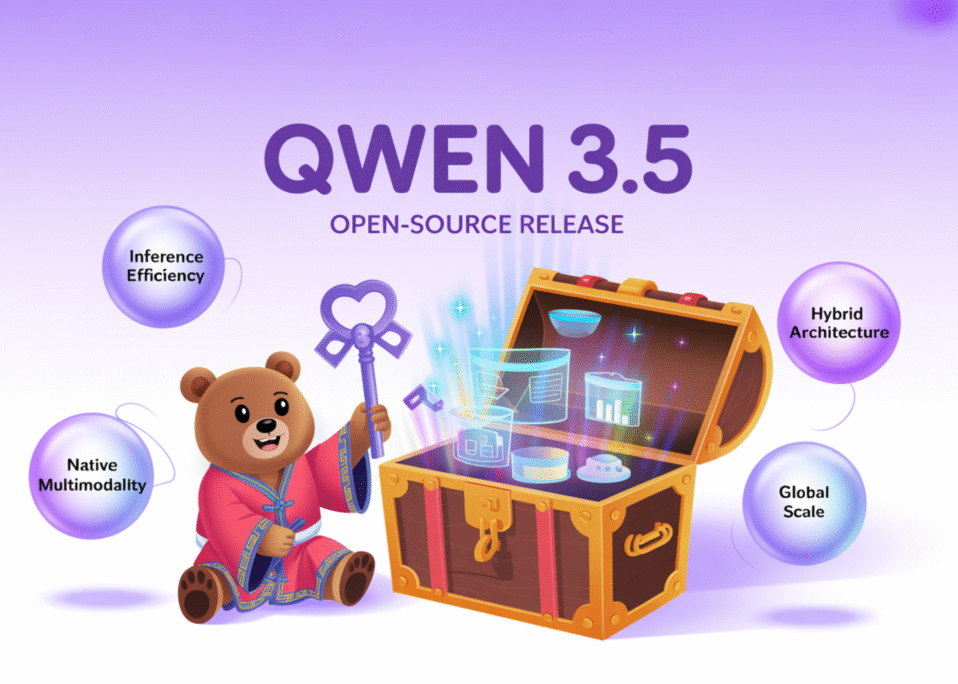
Alibaba’s Qwen team has unveiled Qwen3.5-397B MoE, a cutting-edge Mixture-of-Experts (MoE) language model designed to power next-generation AI agents and complex applications. This model uniquely balances performance and efficiency by activating only 17B of its 397B parameters during inference, making it significantly more computationally efficient than dense models of similar capability. It is engineered for developers, researchers, and enterprises requiring massive context windows (up to 1M tokens) for tasks like long-form document analysis, codebase understanding, and sophisticated multi-step reasoning. The primary benefit is delivering top-tier reasoning capabilities at a fraction of the operational cost of larger dense models.
Key Features and Capabilities
The standout feature of Qwen3.5-397B MoE is its Mixture-of-Experts architecture. Instead of using all 397 billion parameters for every query, the model intelligently routes tasks to specialized “expert” sub-networks, activating only 17 billion parameters at a time. This results in faster inference speeds and lower memory requirements compared to dense models like GPT-4 (which reportedly uses all ~1.7T parameters during inference).
Another critical capability is the massive 1 million token context window. This allows the model to process extensive inputs without losing coherence, making it ideal for analyzing entire books, legal contracts, or large code repositories in a single pass. Its reasoning capabilities have been optimized for complex, multi-step tasks, positioning it as a strong competitor in the AI agent space where planning and tool use are paramount.
Technology Behind It
The model utilizes a sophisticated routing mechanism that analyzes the input and dynamically selects the most relevant expert networks for processing. This MoE architecture is the current industry standard for scaling model capacity without a linear increase in computational cost. Qwen3.5-397B has been trained on a vast corpus of multilingual data, with specific fine-tuning for reasoning, coding, and agent-based interactions. The 1M token context is achieved through advanced positional encoding techniques, likely YaRN or similar scaling methods, ensuring stability over long sequences.
Use Cases and Practical Applications
- AI Agents: The model’s efficiency and long context make it perfect for autonomous agents that need to maintain extensive memory of past interactions and tool outputs while planning future steps.
- Codebase Analysis: Developers can feed entire repositories into the model to ask questions, debug complex issues, or generate documentation that understands the full project structure.
- Legal and Financial Document Review: Analysts can process massive stacks of contracts, reports, or regulatory filings to extract key insights, summarize clauses, and identify risks in one go.
- Research Synthesis: Researchers can upload dozens of papers and ask complex synthesis questions that require connecting concepts across the entire dataset.
Pricing and Plans
As an open-weights model, Qwen3.5-397B MoE is free to download and use for local deployment, provided you have the necessary hardware (high-end GPUs with sufficient VRAM for the 397B total parameters). For those without local infrastructure, Alibaba Cloud offers API access. Pricing typically follows a token-based model (input/output). Expect rates to be competitive, likely lower than GPT-4 Turbo due to the active parameter efficiency, but specific per-token costs should be checked on the official Alibaba Cloud Model Studio pricing page.
Pros and Cons / Who Should Use It
Pros:
- High Efficiency: 17B active parameters offer a great balance of performance and speed.
- Massive Context: 1M tokens is industry-leading and unlocks new application possibilities.
- Cost-Effective: Free to use locally; API costs likely lower than dense competitors.
- Strong Reasoning: Optimized for complex tasks and agent workflows.
Cons:
- Hardware Requirements: Running the full 397B model locally requires significant GPU resources (likely 4x A100 80GB or equivalent).
- Ecosystem Maturity: While Qwen is growing, the tooling and community support are not as extensive as OpenAI’s or Meta’s Llama ecosystems.
- Language Nuance: While multilingual, English-specific nuances might occasionally lag behind native-English models in very subtle contexts.
Who Should Use It:
This model is best suited for technical teams building AI agents, developers needing deep code analysis, and enterprises looking to deploy a powerful, private model for long-context document processing. It is an excellent alternative for those hitting cost or token limits with GPT-4.
FAQ
Is Qwen3.5-397B MoE free to use?
The model weights are open-source and free to download for local deployment. If you use the hosted version on Alibaba Cloud, you will pay based on the number of tokens processed, similar to other API providers.
How does it compare to GPT-4?
In terms of raw reasoning, it is highly competitive. Its main advantage is efficiency; it activates far fewer parameters than GPT-4, potentially offering faster speeds and lower API costs. Its 1M context window also exceeds standard GPT-4 Turbo limits.
What hardware do I need to run this model locally?
To run the full 397B parameter model in bfloat16 precision, you will need approximately 800GB of VRAM (e.g., 10x A100 80GB GPUs). For inference, quantization (like 4-bit) can reduce this requirement significantly, but it remains a high-end setup.
Can it be used for coding tasks?
Yes, the Qwen series has been heavily optimized for coding and reasoning. The large context window allows it to understand entire project structures, making it excellent for debugging and code generation.
What alternatives exist to this model?
Strong alternatives include Meta’s Llama 3.1 405B (dense model), Mixtral 8x22B (MoE), and proprietary models like GPT-4. Qwen3.5-397B distinguishes itself with its specific combination of MoE efficiency and a 1M token context.




















 https://ageofai.tools/u/
How would you rate Alibaba’s Groundbreaking 397B MoE AI Model Pushes Boundaries?