
🎯 KEY TAKEAWAY
If you only take one thing from this, make it these.
Hide
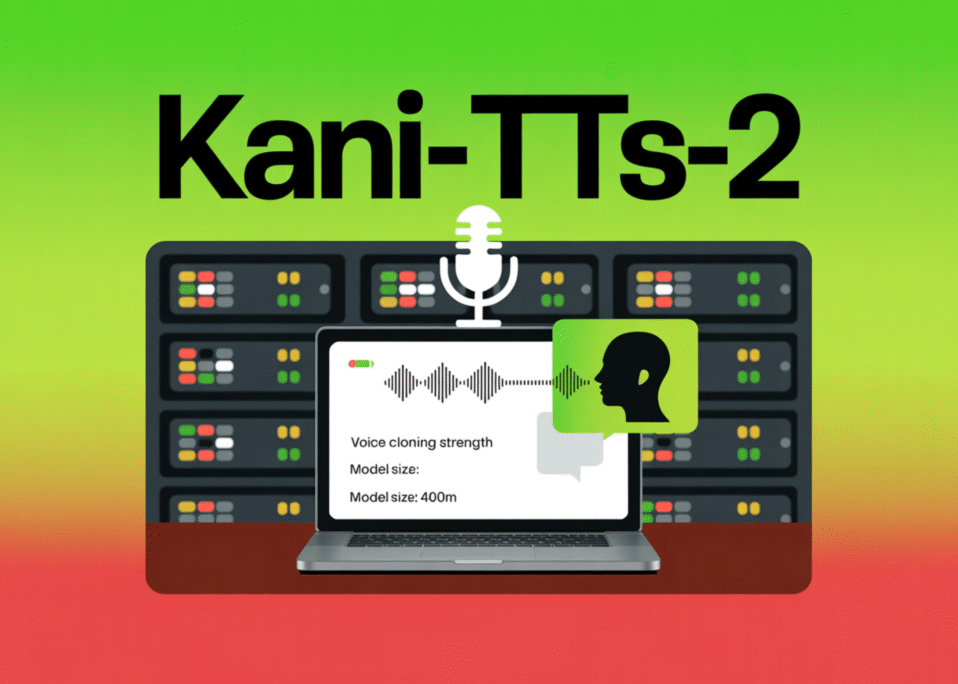
- Kani-TTS-2 is a 400M parameter open-source TTS model that runs efficiently on 3GB VRAM
- Supports high-quality voice cloning from just 3-10 seconds of audio
- Completely free with no usage restrictions, making it ideal for budget-conscious creators
- Best suited for developers, researchers, and technical users comfortable with command-line tools
- Offers unlimited generation capability, unlike character-limited commercial services
- Requires self-hosting but provides complete control over data and customization
- Excellent for edge deployment, accessibility tools, and personalized content creation
Introduction
Kani-TTS-2 is a breakthrough in accessible AI audio technology, offering a compact yet powerful text-to-speech solution that democratizes high-quality voice synthesis. Designed specifically for creators, developers, and hobbyists working with limited hardware, this 400 million parameter model runs efficiently on just 3GB of VRAM while delivering impressive voice cloning capabilities. By balancing performance with accessibility, Kani-TTS-2 solves the common barrier of expensive computing requirements that often excludes smaller teams from advanced TTS applications.
Key Features and Capabilities
Kani-TTS-2 stands out with its remarkably small footprint without sacrificing quality. The model supports voice cloning from short audio samples, allowing users to create custom synthetic voices with minimal reference audio. It delivers natural-sounding speech across multiple languages and maintains consistent prosody and emotional tone throughout longer passages.
The open-source nature of Kani-TTS-2 means complete freedom for modification and integration. Unlike many commercial alternatives, there are no API rate limits or usage restrictions. The model supports both streaming and batch processing, making it suitable for real-time applications like voice assistants as well as offline content creation.
For voice cloning, Kani-TTS-2 requires only 3-10 seconds of clean audio to generate a reusable voice model. The resulting synthetic voice maintains the speaker’s unique characteristics including pitch, timbre, and speaking style. Users can also fine-tune the model on their own datasets for specialized applications.
How It Works / Technology Behind It
Built on a transformer-based architecture, Kani-TTS-2 uses a novel approach to text processing and acoustic modeling. The 400 million parameters are strategically distributed across a text encoder, acoustic model, and vocoder, optimized for efficient inference. The model employs a phoneme-based input system that handles multiple languages robustly.
The voice cloning feature works through a speaker encoder that extracts voice characteristics from reference audio, which are then conditioned throughout the generation process. This approach allows the model to separate content from voice identity, enabling the same text to be spoken in different cloned voices.
For deployment, Kani-TTS-2 uses ONNX runtime for cross-platform compatibility and offers pre-quantized model versions to further reduce memory usage. The system includes built-in voice activity detection and audio preprocessing tools that streamline the cloning workflow.
Use Cases and Practical Applications
Content creators can leverage Kani-TTS-2 for producing audiobooks, podcasts, and video narration without expensive studio time. The voice cloning feature is particularly valuable for branding, allowing companies to create consistent brand voices for marketing materials and product announcements.
Developers building accessibility tools can integrate Kani-TTS-2 into screen readers and assistive technologies. The low resource requirements make it feasible to run these applications on consumer hardware or edge devices.
Educational platforms can generate personalized learning materials with instructor voices, while indie game developers can create diverse character dialogue without hiring large voice acting teams. The model’s efficiency also makes it suitable for mobile applications and IoT devices where computational resources are constrained.
Pricing and Plans
As an open-source project, Kani-TTS-2 is completely free to use, modify, and distribute under the MIT license. There are no licensing fees, subscription costs, or usage restrictions. Users can download the model weights and source code directly from the official GitHub repository.
For those who prefer managed services, third-party platforms like Hugging Face Spaces offer cloud-hosted instances, though these come with their own hosting fees. The project accepts contributions and donations through GitHub Sponsors to support ongoing development.
Compared to commercial alternatives like ElevenLabs or Murf.ai, which charge per character or minute of generated audio, Kani-TTS-2 offers unlimited generation at zero cost. The trade-off is that users handle their own deployment and maintenance rather than relying on a managed service.
Pros and Cons / Who Should Use It
Pros:
- Extremely low hardware requirements (3GB VRAM)
- High-quality voice cloning from short samples
- Completely free and open-source
- Active community support
- Cross-platform compatibility
- No usage restrictions or rate limits
Cons:
- Requires technical knowledge for setup
- Quality may not match latest commercial models
- Limited official documentation compared to paid alternatives
- Community support rather than dedicated customer service
- No built-in user interface (command-line focused)
Kani-TTS-2 is ideal for indie developers, researchers, content creators on a budget, and privacy-conscious users who want to run TTS locally. It’s particularly valuable for projects requiring custom voices without the high costs of commercial services. However, enterprises requiring guaranteed SLAs or non-technical users who need polished interfaces might prefer commercial alternatives.
FAQ
What are the minimum system requirements for running Kani-TTS-2?
Kani-TTS-2 requires at least 3GB of VRAM on NVIDIA GPUs, though it can also run on CPU with increased processing time. The model works on Windows, Linux, and macOS, with Python 3.8+ and PyTorch required. For real-time applications, a GPU is strongly recommended.
How does Kani-TTS-2 compare to ElevenLabs or other commercial TTS services?
Kani-TTS-2 offers comparable quality for many use cases while being completely free and unlimited. However, commercial services provide polished interfaces, guaranteed uptime, and dedicated support. Kani-TTS-2 requires technical setup but gives you complete data privacy and customization control.
Can I use Kani-TTS-2 for commercial projects?
Yes, Kani-TTS-2 is released under the MIT license, which allows commercial use without restrictions. You can modify, distribute, and use the model in commercial products. However, you should ensure any voice cloning respects privacy laws and consent requirements.
What languages does Kani-TTS-2 support?
The base model primarily supports English with strong performance across various accents and speaking styles. Community contributions have added support for additional languages including Spanish, French, and German. Check the GitHub repository for the latest language support updates.
How long does it take to clone a voice with Kani-TTS-2?
The voice cloning process typically takes 5-10 minutes for training on a single GPU, including audio preprocessing. Once trained, generating new speech in the cloned voice takes just seconds. The quality improves with cleaner source audio and longer samples.
What support options are available for Kani-TTS-2?
Support is primarily community-driven through GitHub issues and Discord channels. The project maintainers are active in responding to bug reports and questions. While there’s no formal support contract, the community is helpful and documentation is continuously improving.
Are there user-friendly interfaces available for Kani-TTS-2?
The core model uses command-line tools, but community members have developed web UIs and integrations for platforms like ComfyUI. Some third-party tools have added Kani-TTS-2 support, making it more accessible to non-technical users.
Can I integrate Kani-TTS-2 with my existing applications?
Yes, Kani-TTS-2 provides Python APIs for easy integration. It can be incorporated into web applications, chatbots, content management systems, and mobile apps. The model also supports streaming output for real-time applications and can be containerized for cloud deployment.
How does the voice cloning quality compare to professional voice actors?
For many applications like content narration and accessibility tools, the quality is very convincing. However, it may lack the nuanced emotional range and improvisational ability of professional actors. The cloned voices work best for consistent, clear speech rather than dramatic performances.
What alternatives should I consider if Kani-TTS-2 doesn’t meet my needs?
For similar open-source options, consider Coqui TTS or Piper TTS. If you need managed services, ElevenLabs, Murf.ai, or Play.ht offer polished experiences with higher character limits. For enterprise use, Google Cloud TTS and Amazon Polly provide robust APIs and support.


















 https://ageofai.tools/u/
How would you rate Breakthrough 400M Param Open-Source Text-to-Speech AI Runs in 3GB VRAM?